
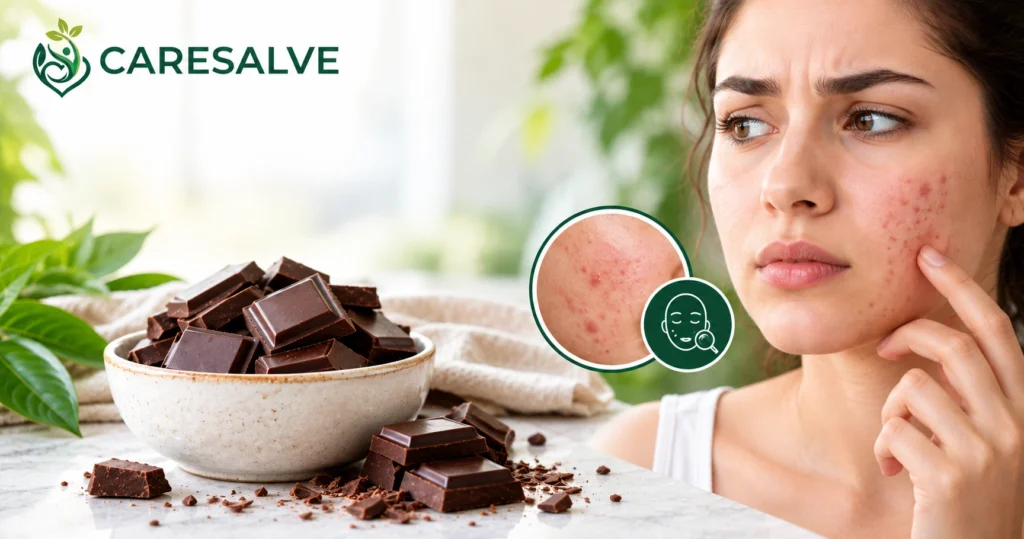

Few food and skin myths get repeated as often as “chocolate causes acne.” Almost everyone has heard it, and plenty of people swear their skin breaks out after eating it. But the science is more nuanced than a flat yes or no. Some research points to a real, measurable link, while other studies find no connection at all. This guide walks through what current research actually shows about chocolate, sugar, dairy, and cocoa, and how to figure out what is going on with your own skin.
What Is Acne?
Acne is a common skin condition that develops when hair follicles, or pores, become clogged with oil and dead skin cells. It shows up as whiteheads, blackheads, pimples, and in more severe cases, deeper cysts or nodules.
Four main factors drive acne: excess oil production from the sebaceous glands, pores clogged with oil and dead skin cells, bacteria (specifically Cutibacterium acnes) multiplying in clogged pores, and the resulting inflammation. Genetics and hormones influence how strongly these factors act in any individual, which is a big part of why acne looks and behaves so differently from person to person.
What Causes Acne?
Excess Oil Production
Sebaceous glands produce an oily substance called sebum to keep skin lubricated. When these glands become overactive, often due to hormones, the extra oil can mix with dead skin cells and clog pores.
Clogged Pores
When oil, dead skin cells, and other debris build up inside a pore, it can form a plug. This is the starting point for whiteheads, blackheads, and eventually inflamed pimples.
Bacteria and Inflammation
Cutibacterium acnes bacteria live on everyone’s skin, but they can multiply rapidly inside clogged, oxygen poor pores. This triggers an immune response and inflammation, which is what causes redness and swelling in a pimple.
Hormonal Changes
Androgens, a group of hormones that rise during puberty and fluctuate during the menstrual cycle, pregnancy, and certain hormonal conditions, stimulate the sebaceous glands to produce more oil, which increases acne risk.
Genetics
A family history of acne raises the likelihood of developing it, since genetics influence oil gland activity, skin cell turnover, and how the immune system responds to bacteria in the pores.
Why Do People Think Chocolate Causes Acne?
The chocolate and acne connection is one of the oldest dietary myths in dermatology, dating back over a century. Many people notice breakouts a day or two after eating chocolate and conclude it must be the cause.
Part of the confusion comes from what chocolate typically contains alongside cocoa: added sugar and dairy, both of which have their own documented links to acne in some populations. Personal experience also plays a role. If someone eats chocolate regularly and also happens to be going through a breakout prone period, hormonally or otherwise, it is easy to draw a direct line between the two, even when other factors are equally or more responsible.
This has led to a common misconception that chocolate itself, as a specific ingredient, directly triggers acne in everyone, when the picture from research is considerably more mixed.
Does Chocolate Cause Acne? What Does Research Say?
The overall research picture is mixed but leans toward a real, if modest, connection for some people. A frequently cited 2014 double blind, placebo controlled trial gave men with a history of acne capsules containing either unsweetened cocoa or a placebo gelatin powder. Researchers found a statistically significant increase in acne lesions by day four and day seven after chocolate consumption compared to baseline, with a positive correlation between the amount of chocolate consumed and the number of new lesions that developed.
That said, this and similar trials tend to involve small numbers of participants, often exclusively men, over short timeframes, which limits how confidently the findings can be generalized. Other reviews looking at diet and acne together have found that the evidence separating chocolate itself from its usual companions, sugar and dairy, is not always clean, since most chocolate consumed in everyday life is not pure, unsweetened cocoa.
The honest answer is that research supports a possible link between chocolate and acne exacerbation in some individuals, but it does not establish that chocolate is a universal or primary cause of acne for everyone.
Can Chocolate Cause Breakouts, Spots, or Pimples?
Individual skin reactions to chocolate vary considerably. Some people can eat chocolate regularly with no noticeable effect on their skin, while others report a fairly consistent pattern of breakouts within a few days of eating it.
It helps to separate two related but different questions: whether chocolate can trigger a breakout in someone prone to acne, and whether it causes acne to develop in someone who would not otherwise have it. Current evidence leans toward the first idea, chocolate may worsen or trigger breakouts in acne prone individuals, more than the second.
So can chocolate cause pimples or spots? For some people, especially those already prone to acne, the answer based on available trials appears to be yes, at least as a contributing trigger rather than a sole cause.
Does Milk Chocolate Give You Acne?
Milk chocolate contains added sugar and dairy solids on top of cocoa, both of which have their own associations with acne in certain populations. A systematic review of dietary and acne research found that a high glycemic load diet and dairy consumption, particularly milk, were commonly identified as contributing dietary factors.
This is part of why milk chocolate is often viewed with more suspicion than darker chocolate with a higher cocoa percentage and less sugar. Some research summarized in dermatology literature has suggested that white chocolate, which contains no cocoa solids and relies heavily on sugar and milk fat, shows a clearer association with worsening acne than dark chocolate does, though the overall evidence for chocolate type specifically remains limited.
In short, it may be less about chocolate as a single category and more about the added sugar and dairy content of a particular chocolate product.
Does Chocolate Make You Break Out?
Several overlapping factors can explain why someone notices breakouts after eating chocolate. Sugar and dairy sensitivity is one possibility, since both have documented, if inconsistent, associations with acne. Overall diet patterns matter too. Someone eating chocolate as part of a broader high sugar, high glycemic diet may see more skin changes than someone who eats chocolate occasionally within an otherwise balanced diet.
Stress is another confounding factor. Stress can independently worsen acne through hormonal pathways, and stress often coincides with comfort eating, including chocolate, which can make it look like the chocolate itself is the trigger when stress may be doing much of the work.
Finally, coincidence plays a real role. A pimple that was already forming under the skin, a process that takes days to weeks, may simply become visible around the same time chocolate was eaten, without the two being causally connected.
Does Chocolate Create Acne or Pimples?
There is an important difference between chocolate causing acne to develop in the first place and chocolate worsening acne that a person already has a tendency toward. Most of the available evidence points toward the second scenario: chocolate, or more specifically its sugar and dairy content, may exacerbate existing acne-prone skin rather than being the root cause of acne in someone who would not otherwise develop it.
Individual variation is significant here as well. Hormones, genetics, skincare habits, and other dietary factors all interact, which is why one food is unlikely to fully explain any individual’s breakouts on its own.
How to Find Out If Chocolate Affects Your Skin
Step 1: Track Your Food and Breakouts
Keep a simple daily log of what you eat, including chocolate and other common dietary suspects like dairy and high sugar foods, alongside notes on new breakouts, their timing, and severity.
Step 2: Look for Patterns
After a few weeks, review your log for consistency. Since new acne lesions typically take several days to fully form after the initial trigger, look at what you ate roughly two to seven days before a breakout, not just the day before.
Step 3: Discuss Persistent Acne With a Dermatologist
If a pattern seems clear, or if acne persists regardless of diet changes, a dermatologist can help interpret the pattern alongside other factors like hormones, skincare routine, and medication. Avoid drawing overly strict conclusions from a short personal experiment. Diet is only one of several factors that influence acne, and eliminating a food without a clear, consistent pattern may not lead to meaningful improvement.
Other Factors That May Affect Acne
High-Glycemic Foods
Diets high in refined carbohydrates and sugar can spike blood sugar and insulin, which may increase androgen activity and oil production. A number of studies and reviews have found a positive association between high glycemic load diets and acne severity.
Dairy
Dairy, particularly skim milk, has shown an association with acne in several studies, though the evidence is less consistent than for glycemic load and may depend on the population studied.
Hormones
Fluctuations in androgens during puberty, the menstrual cycle, pregnancy, or conditions like polycystic ovary syndrome can significantly influence oil production and acne severity.
Stress
Stress can increase hormone levels linked to oil production and inflammation, and has been associated with acne flares in multiple studies.
Sleep
Poor sleep is linked to increased inflammation and stress hormone levels, both of which can plausibly contribute to acne, although this connection is less directly studied than diet and hormones.
Skincare Habits
Using comedogenic (pore clogging) products, not removing makeup thoroughly, or over washing and irritating the skin can all contribute to breakouts independent of diet.
Should You Stop Eating Chocolate?
For most people, completely avoiding chocolate is not necessary. If you notice a consistent, personal pattern linking chocolate to breakouts, moderation is a reasonable first step rather than total elimination.
Choosing chocolate with less added sugar, such as options with a higher cocoa percentage, may be worth trying, since sugar and dairy content appear more consistently linked to acne than cocoa itself in the research reviewed here. More broadly, it is worth focusing on your overall diet pattern, including sugar and dairy intake as a whole, rather than treating chocolate as the single food responsible for your skin.
When Should You See a Dermatologist?
Diet experiments and skincare adjustments have their limits. It is time to see a dermatologist if you experience:
- Persistent or worsening acne despite consistent skincare and dietary changes.
- Painful or deep pimples, cysts, or nodules.
- Acne that is starting to cause scarring or dark marks.
- Breakouts that do not improve with basic over the counter treatments.
Frequently Asked Questions
1. Does chocolate cause acne?
Chocolate is unlikely to be a universal cause of acne in everyone, but research, including a placebo controlled trial using unsweetened cocoa, suggests it may worsen acne in people who are already prone to it.
2. Can chocolate cause breakouts?
Yes, for some people. Individual sensitivity varies, and factors like added sugar and dairy in typical chocolate products may play as large a role as the cocoa itself.
3. Does chocolate make pimples worse?
In acne prone individuals, some clinical research has found an increase in the number of lesions following chocolate consumption, suggesting it can worsen existing acne for some people.
4. Does milk chocolate give you acne?
Milk chocolate’s sugar and dairy content give it a plausible link to acne based on broader diet and acne research, potentially more so than darker chocolate with less sugar and no milk solids.
5. Can chocolate cause spots?
It may, particularly in people already prone to breakouts, though the size of the effect and how it varies from person to person is still not fully settled by current research.
Conclusion
Chocolate does not appear to cause acne in everyone, but for people who are already acne prone, research suggests it can act as a trigger or contribute to worsening breakouts. Ingredients commonly paired with chocolate, especially added sugar and dairy, may be just as relevant as cocoa itself. Because individual response varies so much, tracking your own patterns is more useful than assuming chocolate is universally to blame. If your acne is persistent, painful, or affecting your confidence, a dermatologist can help identify what is actually driving it and build a treatment plan that fits your skin.
References
- Vongraviopap S, Asawanonda P. Double-blind, placebo-controlled study assessing the effect of chocolate consumption in subjects with a history of acne vulgaris. Journal of Clinical and Aesthetic Dermatology / PubMed: https://pubmed.ncbi.nlm.nih.gov/24847404/
- Dréno B, Bettoli V, Araviiskaia E, Sanchez Viera M, Bouloc A. The influence of exposome on acne. Journal of the European Academy of Dermatology and Venereology. 2018. Referenced via PubMed: https://pubmed.ncbi.nlm.nih.gov/29377341/
- Diet and acne: A systematic review. JAAD International. Available at: https://www.jaadinternational.org/article/S2666-3287(22)00028-1/fulltext
- Bin Mohd Tambi MI, et al. High glycemic load diet, milk and ice cream consumption are related to acne vulgaris in Malaysian young adults: a case control study. BMC Dermatology. Available via NCBI: https://www.ncbi.nlm.nih.gov/pmc/articles/PMC3470941/
- Burris J, Rietkerk W, Woolf K. Acne: the role of medical nutrition therapy. Journal of the Academy of Nutrition and Dietetics. Summarized via ScienceDaily: https://www.sciencedaily.com/releases/2013/02/130220084809.htm
This article is for informational purposes only and does not replace professional dental or medical advice. If you have persistent oral health symptoms, please consult a dentist or physician.
