

Last updated: September 14, 2026. Measles outbreak numbers change quickly, so figures below are attributed to their source and date. Read our full Editorial Policy to learn how we fact check content.
What Is Happening With the Measles Outbreak in Pennsylvania?
Pennsylvania is in the middle of its largest measles outbreak in decades. According to the Pennsylvania Department of Health’s statewide measles update, the state had reported 676 confirmed measles cases across 37 counties as of September 11, 2026, with more than 100 new cases added in a single week. The outbreak is centered in Lancaster County, which health officials have called the epicenter of the spread.
Almost all of the reported cases are among people who were not vaccinated against measles. The situation has also become politically charged, with a public disagreement between Pennsylvania officials and federal health leaders, including Health and Human Services Secretary Robert F. Kennedy Jr. and CDC Director Dr. Erica Schwartz, over how the state’s measles associated deaths are being reported and classified.
How Many Measles Cases Have Been Reported in Pennsylvania?
As of September 11, 2026, Pennsylvania’s Department of Health reported:
- 676 confirmed measles cases
- Cases spread across 37 counties
- 124 hospitalizations
- Three measles associated deaths
Nationally, the CDC’s measles case and outbreak data shows 3,294 confirmed measles cases across the United States as of September 10, 2026, spanning 47 jurisdictions. About 95 percent of those cases were linked to identifiable outbreaks.
Because these numbers are updated frequently (Pennsylvania’s total rose from 624 to 676 in just two days in early September), always check the state’s official measles dashboard for the most current count rather than relying on a single snapshot.
Where Have Measles Exposures Been Reported in Pennsylvania?
Pennsylvania health officials have issued a series of public exposure alerts as the outbreak has spread, asking anyone who visited certain locations on specific dates to monitor themselves for symptoms. Past alerts have included sites in Lancaster County such as a local university campus and a grocery store, among others.
Because exposure locations and dates change constantly, it is safest to check the Pennsylvania Department of Health’s official newsroom or measles page directly for the most recent list rather than relying on an older report. If you believe you were exposed, contact your healthcare provider and mention the possible exposure before visiting in person, so the office can take precautions to protect other patients.
Why Is Lancaster County Being Mentioned So Often in the Measles Outbreak?
Lancaster County has been described by health officials as the center of Pennsylvania’s outbreak. The state’s first two measles associated deaths in this outbreak, confirmed on August 25, 2026, were both unvaccinated residents of Lancaster County, and they marked the state’s first measles deaths in 35 years. A third measles associated death, reported on September 13, 2026, involved a 40 year old unvaccinated woman from Jefferson County, showing that the outbreak has since spread beyond Lancaster to other parts of the state.
What Are the Symptoms of Measles?
According to the CDC’s overview of measles (rubeola), early measles symptoms typically appear seven to fourteen days after infection and can include:
- High fever
- Cough
- Runny nose
- Red, watery eyes
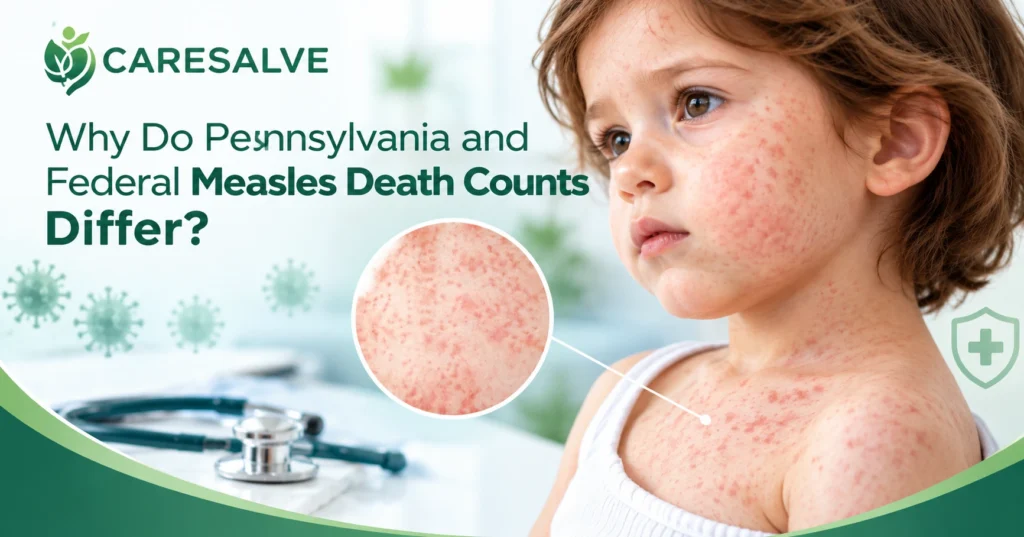
- A rash that usually starts on the face and spreads down the body
People with measles can spread the virus to others for several days before the rash even appears, which is part of why the disease moves so quickly through communities with low vaccination rates.
Who Is Most at Risk During a Measles Outbreak?
The people at greatest risk during a measles outbreak generally include:
- Unvaccinated individuals of any age
- Young children who have not yet completed their vaccine series
- Infants too young for routine MMR vaccination
- People with weakened immune systems
- Anyone with a known or suspected exposure to a confirmed case
Nationally, CDC kindergarten vaccination coverage data shows MMR coverage has declined from about 95.2 percent in the 2019 to 2020 school year to roughly 92.4 percent in 2025 to 2026, leaving an estimated 280,000 kindergartners without documented protection and pushing many communities below the immunity threshold needed to reliably prevent outbreaks.
How Can You Protect Yourself During the Pennsylvania Measles Outbreak?
The most effective protection remains the MMR (measles, mumps, and rubella) vaccine. Pennsylvania Department of Health guidance on measles notes that two doses of the MMR vaccine provide about 97 percent protection against measles.
Steps you can take include:
- Checking your own and your family’s vaccination records
- Talking to a healthcare provider if you are unsure whether you or your children are up to date
- Avoiding known exposure sites when possible
- Calling ahead before visiting a doctor’s office or emergency room if you suspect measles, so staff can prepare to prevent further spread
- Monitoring for symptoms if you may have been exposed, even if you feel fine at first
How Many People Have Died From Measles in the United States?
This is an area where you may see conflicting numbers, and it’s worth understanding why.
Pennsylvania has reported three measles associated deaths connected to this outbreak: two Lancaster County residents confirmed in late August 2026, and a Jefferson County woman who died on September 12, 2026. All three were unvaccinated.
At the national level, the CDC’s official measles case and death tracker, last updated around September 10, 2026, has not listed any confirmed 2026 measles deaths. Instead, the CDC page includes a note explaining that the National Center for Health Statistics does not currently have any death records from 2026 that list measles as the underlying cause. CDC has said it is working with the Council of State and Territorial Epidemiologists to build a standardized definition for classifying measles deaths, and that its own reporting will be updated once reviews are complete.
Why Do Pennsylvania and Federal Measles Death Counts Differ?
Rather than treating this as one side being right and the other wrong, it helps to understand how death classification works. A state health department, like Pennsylvania’s, can confirm a measles associated death using its own case definition once certain clinical and lab criteria are met. Federal agencies such as the CDC often rely on separate national vital statistics systems, which can take longer to formally classify and record a cause of death, especially while reviews are still underway.
In short: measles death counts can differ between state and federal reporting because cases are reviewed, defined, and classified differently, and those processes do not always move on the same timeline. If you are looking for the most current death count specific to Pennsylvania, the state Department of Health is currently the more up to date source for this outbreak. For broader national historical data, the CDC remains the standard reference once its review process is complete.
A Final Note on This Outbreak
Because this is an active, evolving public health event, treat any specific case count, hospitalization figure, or death toll as a snapshot in time tied to the date it was reported, not a permanent number. For the most current information, check the Pennsylvania Department of Health’s measles page and the CDC’s measles data page directly, and talk to a healthcare provider about your own or your family’s vaccination status if you have any concerns.
This article is for general information only and is not a substitute for medical advice. If you think you or your child may have measles, contact a healthcare provider promptly.
