

A Note From CareSalve: This article is written for informational and educational purposes to support your mental wellness journey. CareSalve does not provide medical diagnoses, treatment plans, or a substitute for professional care. If you are experiencing distressing physical symptoms, please consult a licensed medical provider.
Picture this. A nurse jokes about needing a vacation “six feet under” right after a brutal overnight shift. A friend who just lost their job laughs and says they’re finally free to become a professional napper. Someone at a funeral cracks a joke that makes half the room gasp and the other half laugh so hard they cry.
If you’ve ever made a joke like this, or laughed at one, you’ve probably wondered what that says about you. At CareSalve, we hear this question often: is it normal to laugh at things that are supposed to be sad, scary, or even tragic?
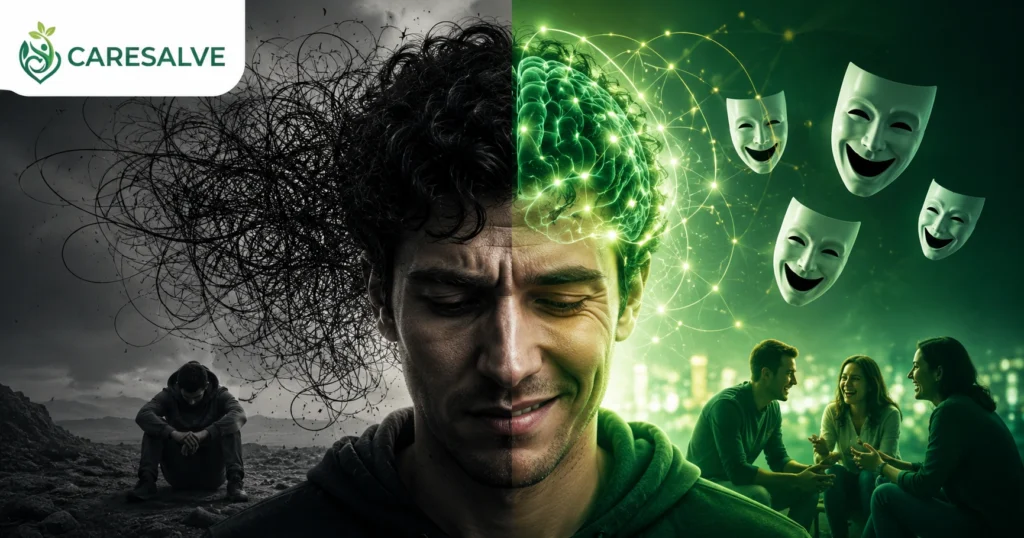
The short answer is yes, and it’s far more common, and far more psychologically interesting, than most people realize. Dark humor, often called gallows humor, is the practice of finding comedy in subjects that are typically treated as serious, painful, or taboo. In many cases, using it isn’t a sign that something is wrong with you. It’s a sign that your brain is doing exactly what it’s built to do: protect you from being overwhelmed by pain it can’t otherwise process in the moment.
In this guide, we’ll cover:
- What dark humor actually is, and how it differs from other types of comedy
- The psychology behind why we use it as a coping mechanism
- What happens in the brain when a dark joke lands
- What your specific brand of dark humor might reveal about you
- How to tell the difference between humor that heals and humor that hides
- A simple self assessment to check in with your own relationship to your jokes
What Is Dark Humor? Definitions and Core Concepts
At its core, dark humor (also called gallows humor, morbid humor, or black comedy) is comedy that treats grim, frightening, or taboo subjects with the same casual tone usually reserved for lighthearted topics. It takes something that “shouldn’t” be funny and finds the absurd, ironic, or exaggerated angle hiding inside it.
This is different from a few nearby styles of comedy:
- Shock humor aims purely to provoke a reaction through crude or offensive content, often without any deeper point
- Cynicism is really just pessimism dressed up as commentary
- Dark humor typically still has structure and intent, pointed at something real like mortality, illness, grief, or fear, softened through comedic timing
Psychologists often explain why this works through the benign violation theory. Something strikes us as funny when it violates a norm, whether moral, social, or physical, but the violation is perceived as safe, or “benign,” at the same time. A joke about death violates the norm that death should be treated with solemn respect. If the listener’s brain reads that violation as safe rather than threatening, the tension resolves as laughter instead of distress. This is exactly why the same joke can be hilarious to one person and horrifying to another.
Gallows humor also has deep historical roots. The term itself refers to condemned prisoners who joked about their own execution on the way to the gallows, a final act of defiance against fear. Soldiers in the trenches of World War I used dark jokes to cope with the constant presence of death, and doctors and nurses in emergency rooms have long relied on morbid humor to survive shifts filled with trauma most people never witness. This isn’t a modern trend. It’s a deeply human survival tool.
The Psychology Behind Dark Humor as a Coping Mechanism
Sigmund Freud actually placed humor among the “mature” psychological defense mechanisms, ranking it alongside traits like altruism and sublimation. Unlike defenses such as denial or repression, which distort or bury reality, humor lets a person acknowledge painful reality directly while creating enough emotional distance to bear it.
A few mechanisms explain how this plays out day to day:
- Cognitive reframing. Turning a painful experience into a punchline changes the story your brain tells about it, shifting from “this happened to me and I was powerless” to “here’s the absurd angle I can now see in it”
- Restoring agency. Trauma and hardship strip away a sense of control. Making the joke yourself hands some of that control back, turning you from the victim of the circumstance into the narrator of the story
- Emotional distance. Processing grief or fear all at once can be overwhelming. Humor lets the mind approach painful material in smaller, more manageable doses
The Neuroscience of Morbid Humor: What Happens in the Brain?
When we encounter something frightening, the amygdala, the brain’s threat detection center, fires up first and triggers the classic stress response. Humor engages the prefrontal cortex, the region responsible for complex reasoning and irony. When a dark joke lands successfully, the prefrontal cortex essentially helps down regulate the amygdala’s alarm signal, so the brain can process disturbing content without staying locked in full fear mode.
There is also a real chemical reward at play. Laughter releases endorphins, drops cortisol (the primary stress hormone), and boosts dopamine, tied to reward and pleasure. In high stress environments, whether a hospital, a battlefield, or just a brutal week at home, this relief loop gives the nervous system a genuine physiological break, even if it lasts only a few seconds.
Chronic stress and trauma, including PTSD, can also change how the brain processes threat and emotion over time. People who have lived through prolonged hardship often develop a different sense of what feels “safe enough” to laugh about, which is part of why someone with a heavy personal history might find humor in situations that feel shocking to others who haven’t shared that experience.
The Psychological Decoder: What Your Dark Jokes Say About You
Not all dark humor comes from the same place. The specific flavor of joke someone gravitates toward can offer a small window into what they’re actually working through:
- Death and mortality humor often reflects an attempt to process existential anxiety, the universal fear of the unknown that comes with being mortal
- Self deprecating trauma jokes frequently serve as a buffer against low self worth or anticipated criticism, taking away the sting by making the joke about yourself first
- Absurdist and shock humor tends to highlight the chaotic or meaningless nature of a stressful situation, common in people trying to make sense of events that genuinely don’t make sense
- Medical and frontline gallows humor, common among ER doctors, nurses, first responders, and military personnel, functions largely as an occupational survival tactic and a shared language among teams who witness suffering together
The Dark Side: When Dark Humor Becomes Emotional Avoidance
Dark humor is a genuinely useful coping tool, but like any tool, it can be misused. A few signs the line has been crossed:
- Deflecting instead of coping. Healthy dark humor sits alongside real emotional processing, you can laugh and still cry later, still talk seriously when needed. Deflecting is when the joke becomes the only response available, shutting down deeper conversation before it starts.
- Social isolation. Jokes that land well with people who share your context can land very differently with people outside it. When humor consistently makes others uncomfortable or hurt, it can push away the people who might otherwise offer real support.
- The jester’s mask. There’s a risk in becoming known as “the funny one.” Over time, people may stop checking in on you, assuming the jokes mean everything is fine, until the mask never comes off, even privately.
Interactive Self Assessment: Is Your Dark Humor Healthy?
Run through this simple four point check honestly with yourself:
- Awareness. Do you know what emotion you’re actually hiding behind the joke?
- Flexibility. Can you talk about the issue seriously when the moment calls for it, or does every conversation get rerouted into a punchline?
- Aftermath. After the laughter fades, do you feel a bit lighter, or still empty and anxious underneath?
- Connection. Does your humor bring people closer, or does it build a wall that keeps people at a distance?
If you answered mostly toward awareness, flexibility, relief, and connection, your dark humor is likely functioning as a healthy coping tool. If you found yourself leaning toward numbness, rigidity, or distance, that’s not a reason for alarm, but it may be worth exploring with a therapist or someone you trust.
How to Navigate Dark Humor in Therapy and Daily Life
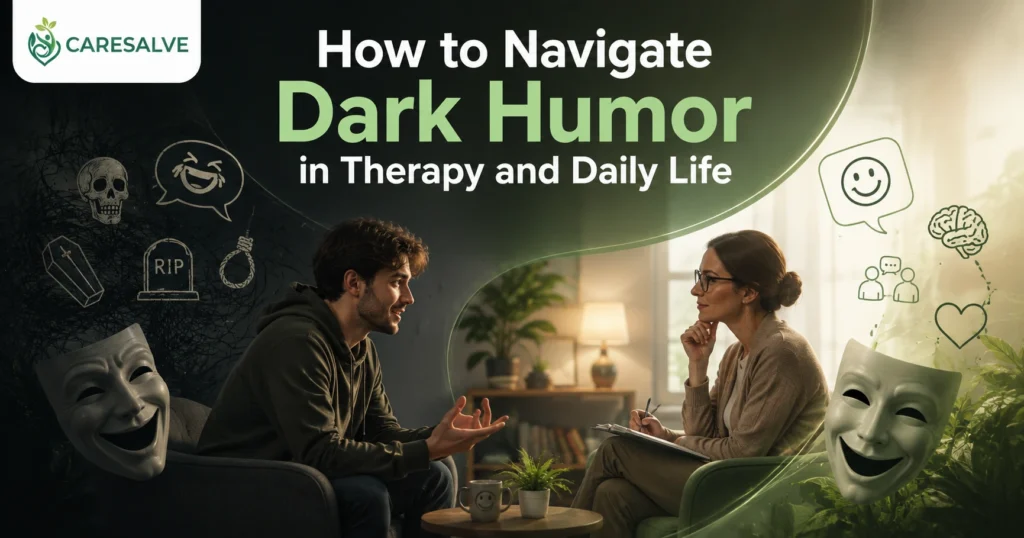
A common fear is that a therapist will judge dark jokes as inappropriate. In reality, most experienced therapists welcome dark humor in session, since it often reveals what a client is truly feeling and can serve as a natural bridge into harder conversations. You don’t need to censor yourself to be taken seriously in therapy.
Outside of therapy, a few practical habits help:
- Set boundaries with others. If your jokes make someone uncomfortable, try checking in directly (“I process hard stuff with jokes, is that okay with you?”) and be willing to dial it back when needed.
- Build a fuller toolkit. Dark humor works best alongside other coping tools rather than as the only one. Journaling, somatic grounding techniques, and ongoing therapy all give you somewhere else to turn when humor isn’t enough.
Conclusion and Final Verdict
If you find yourself laughing at things that are supposed to be sad, scary, or off limits, it doesn’t mean something is wrong with you. More often than not, it means your mind found a clever, resourceful way to survive something difficult. Dark humor, used well, is a genuine sign of resilience, not malice.
The balanced take is simple: it’s okay to laugh at the dark stuff, as long as you’re also willing to eventually sit with what’s underneath it. Humor can open the door to hard feelings. It shouldn’t be the only room you ever let yourself enter.
If any of this resonated with you, we’d love to hear from you. Share your own experience with dark humor in the comments, and if you’re curious about building a broader toolkit for emotional resilience, explore more mental health resources here at CareSalve.
Frequently Asked Questions
1. What is the psychological definition of dark humor?
Dark humor, sometimes called gallows humor, refers to comedy that treats serious or taboo subjects, such as death, illness, or trauma, with a casual tone. It functions as a defense mechanism that lets a person acknowledge painful realities while creating emotional distance to manage them.
2. Is having a dark sense of humor a sign of mental illness or trauma?
Not inherently. Research generally treats dark humor as a mature and often healthy coping mechanism. It becomes a concern only when it consistently replaces genuine emotional processing or pushes away meaningful support.
3. Why do first responders and healthcare workers use gallows humor?
People in high stress, high exposure professions rely on gallows humor as a shared occupational coping tool. It helps teams process repeated exposure to suffering without becoming overwhelmed, while also building camaraderie.
4. How can I stop using jokes to hide my real feelings?
Start by naming the emotion underneath the joke to yourself. Practice pausing before deflecting into humor, and try sharing the serious version of the story with someone you trust or with a therapist.
5. Will a therapist judge me if I make dark jokes during a session?
Most therapists welcome dark humor as useful material rather than something to judge. It often reveals what a client is truly feeling and can serve as a natural entry point into deeper conversations.
References
- Alexander, D. A., & Klein, S. (2001). Ambulance personnel and critical incidents: Impact of accident and emergency work on mental health and emotional well-being. British Journal of Psychiatry, 178(1), 76–81. https://doi.org/10.1192/bjp.178.1.76
- Martin, R. A., Puhlik-Doris, P., Larsen, G., Gray, J., & Weir, K. (2003). Individual differences in uses of humor and their relation to psychological well-being: Development of the Humor Styles Questionnaire. Journal of Research in Personality, 37(1), 48–75. https://doi.org/10.1016/S0092-6566(02)00534-2
- McGraw, A. P., & Warren, C. (2010). Benign violations: Making immoral behavior funny. Psychological Science, 21(8), 1141–1149. https://doi.org/10.1177/0956797610376073
- Mobbs, D., Greicius, M. D., Abdel-Azim, E., Menon, V., & Reiss, A. L. (2003). Humor modulates the mesolimbic reward centers. Neuron, 40(5), 1041–1048. https://doi.org/10.1016/S0896-6273(03)00751-7
- Willinger, U., Hergovich, A., Schmoeger, M., Feldman, M., Vogrincic, C., Kassowitz, M., … & Aauff, E. (2017). Cognitive and emotional demands of black humor processing: The role of intelligence, aggressiveness, and mood. Cognitive Processing, 18(2), 159–167. https://doi.org/10.1007/s10339-016-0789-y
