

A Note From CareSalve: This article is written for informational and educational purposes to support your mental wellness journey. CareSalve does not provide medical diagnoses, treatment plans, or a substitute for professional care. If you are experiencing distressing physical symptoms, please consult a licensed medical provider.
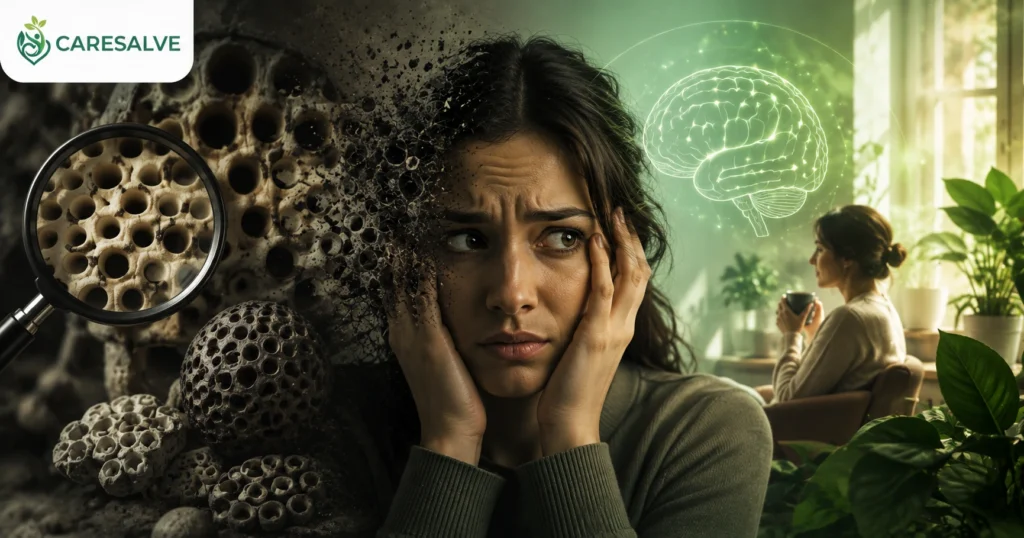
You’re scrolling through your phone when a photo of a lotus seed pod, a honeycomb, or a cluster of bubbles pops up on screen. Before you’ve even consciously registered what you’re looking at, your skin starts crawling. Your stomach turns. Some part of you wants to look away immediately, and another part can’t stop staring. If that reaction sounds familiar, you’re not imagining things, and you’re definitely not alone. At CareSalve, this is one of the most common visual reactions people write in about, and there’s a real name for it.
Trypophobia is the aversion to, or fear of, closely packed holes, bumps, or repetitive circular patterns. It’s worth clarifying something right away: trypophobia is recognized as a genuine visual aversion or phobia, but it is not currently listed as its own official diagnosis in the DSM 5, the manual clinicians use to classify mental health conditions. That doesn’t make the reaction any less real. It simply means the condition is still being studied and understood.
In this guide, we’ll walk through:
- What trypophobia actually means and where the word comes from
- The most common triggers, from nature to food to skin related imagery
- The physical and psychological symptoms people experience
- The leading evolutionary theories for why our brains react this way
- How it’s diagnosed and separated from other conditions
- Practical ways to manage or reduce the reaction over time
What Is Trypophobia? Definitions and Core Concepts
Meaning and Etymology
The word trypophobia comes from Greek. “Trypa” means hole, and “phobos” means fear. Put together, it literally translates to fear of holes. The term is relatively modern, first coined online in the mid 2000s, but the reaction itself has almost certainly existed for as long as humans have been looking at clustered, repetitive patterns.
Common Names and Search Queries Answered
People describe this experience in a lot of different ways, and they’re usually all pointing to the same phenomenon:
- Fear of holes, or fear of small holes
- Phobia of clusters, bubbles, dots, and circular patterns
- Fear of irregular or repeated holes
Trypophobia vs Traditional Phobias
Most classic phobias, like a fear of heights or a fear of enclosed spaces, are rooted primarily in fear and the anticipation of danger. Trypophobia works a bit differently. Research suggests it’s driven more by disgust and a strong visual aversion than by pure panic based fear. This is part of why the reaction can feel less like “I’m scared” and more like “I’m repulsed,” even though the physical sensations can overlap quite a bit.
Common Trypophobia Triggers
Trigger patterns show up across nature, everyday objects, animals, and, in some of the more viral and misleading cases online, human skin.
Natural and Plant Triggers
- Lotus seed pods
- Honeycombs
- Sunflower seed heads
- Coral formations
Everyday Objects and Food Triggers
- Sponges
- Aeration holes in bread or crumpets
- Bubble wrap
- Swiss cheese
- Condensation droplets and foam
Animal and Biological Triggers
- The Surinam toad, whose back holds developing eggs in small pits under the skin
- Poison dart frog skin patterns
- The rings of a blue ringed octopus
Skin and Body Related Triggers
This is one of the most searched, and most misunderstood, categories. Some real biological conditions can genuinely present with clustered, hole like patterns, including enlarged pores, clusters of hair follicles, certain skin lesions, and insect bite marks. These are legitimate dermatological features that can trigger a trypophobic response in sensitive individuals.
Separately, a wave of viral “holes in skin” or “hole in hand” images has circulated online over the years. It’s important to be clear here: the vast majority of these dramatic viral photos are the product of special effects makeup or digital editing, not an actual medical condition. They’re designed specifically to shock, which is very different from the naturally occurring biological triggers listed above.
Symptoms: How Do You Know If You Have It?
Trypophobia can show up through both the body and the mind, and the intensity varies a lot from person to person.
Physical Responses
- Goosebumps
- A crawling sensation on the skin
- Nausea
- Shivering
- Sweating
- A racing heartbeat
- Dizziness
Psychological and Visual Responses
- Intrusive thoughts about the pattern after looking away
- Intense discomfort or a sense of being repulsed
- An urge to destroy, cover, or avoid the pattern entirely
Mild Discomfort vs Extreme Trypophobia
There’s a meaningful difference between standard visual irritation, the kind most people feel briefly when they see a honeycomb up close, and a more extreme, panic inducing aversion that genuinely impacts daily life. If your reaction is strong enough to disrupt your day, your sleep, or your ability to function around common imagery, that points toward the more severe end of the spectrum.
What Causes Trypophobia? The Evolutionary Science
The leading explanation for trypophobia isn’t psychological trauma or a learned fear. It’s evolutionary. Researchers largely point to something called the evolutionary survival hypothesis.
Poisonous Animals
One theory suggests that clustered hole patterns visually resemble the markings of venomous or dangerous animals, snakes, certain spiders, and octopuses among them. On a deep, ancestral level, the brain may have learned to treat this kind of visual pattern as a warning sign worth reacting to instantly, well before conscious thought catches up.
Parasites and Infectious Disease
A second, closely related theory ties the reaction to disease avoidance. Clustered holes and bumps resemble the visual signs of skin parasites, pox, infections, and open wounds, all things our ancestors would have benefited enormously from avoiding on sight. In this view, trypophobia is essentially an overactive, but historically useful, disease detection system.
The Visual Feature Behind the Reaction
There’s also a purely visual, almost mathematical explanation. Trypophobic images tend to share specific spectral properties, particularly high spatial contrast and certain spatial frequencies. These properties can overload the brain’s visual processing system, creating a sense of unease even before the brain identifies what it’s actually looking at.
Why Some People Have It Worse
Not everyone reacts to these images with the same intensity, and that largely comes down to individual sensitivity to high contrast visual geometry. Some brains are simply more responsive to this specific kind of pattern, which is part of why the same image can barely register for one person and feel unbearable for another.
How Is Trypophobia Diagnosed?
Lack of Formal DSM 5 Criteria
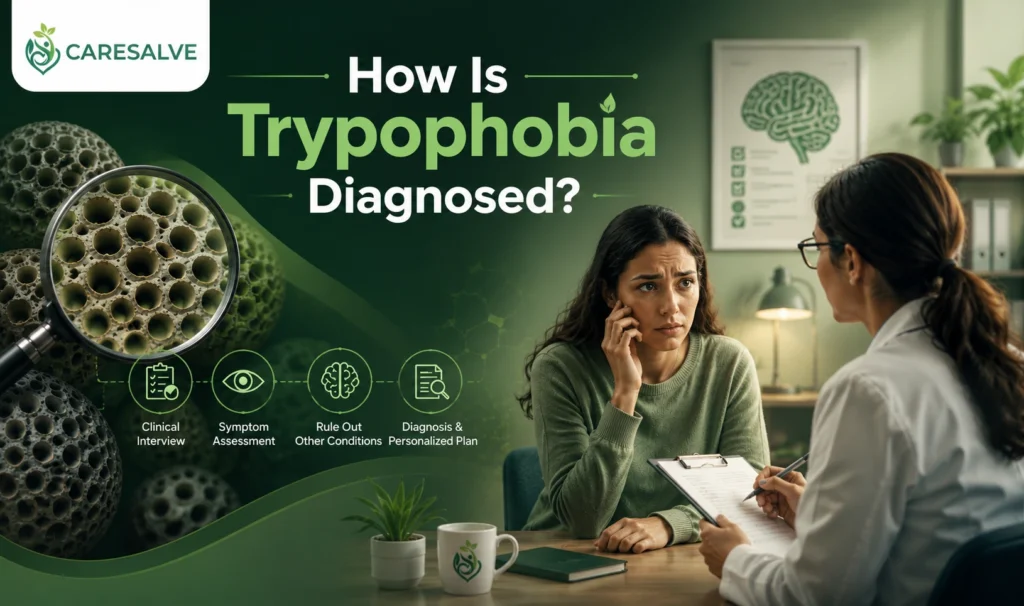
Because trypophobia doesn’t have its own dedicated entry in the DSM 5, doctors and clinicians typically classify it under the broader category of specific phobias when it causes real, significant distress. The absence of a standalone diagnosis doesn’t mean the experience isn’t taken seriously, it just means it gets folded into an existing diagnostic framework.
Self Assessment and Online Tests
A number of visual sensitivity tests exist online, generally showing a series of high contrast cluster pattern images and measuring the strength of a person’s reaction. These can be a useful starting point for self awareness, though they’re not a substitute for a conversation with a mental health professional if the reaction is significantly affecting your life.
Differentiating Conditions
Before assuming trypophobia is the full picture, it’s worth ruling out a few related conditions:
- Generalized anxiety disorder, where the reaction might be part of a broader pattern of heightened anxiety
- OCD, particularly contamination related fears, which can sometimes overlap with reactions to skin or hole imagery
- Dermatological anxiety, a more specific worry centered on skin health and appearance
How to Overcome or Manage Trypophobia
The good news is that trypophobia is very manageable, even when the reaction feels intense in the moment. A combination of approaches tends to work best.
Cognitive Behavioral Therapy (CBT)
CBT focuses on identifying and rewiring the negative thought loops that form around triggering visual patterns. Instead of the automatic thought “this is dangerous,” CBT helps build a more accurate, calmer interpretation of what’s actually being seen.
Exposure Therapy (Systematic Desensitization)
This involves gradual, controlled exposure to mild trigger imagery, slowly increasing intensity over time under safe, manageable conditions. The goal is to reduce the brain’s sensitivity to the pattern step by step, rather than avoiding it entirely, which tends to keep the reaction just as strong long term.
Mindfulness and Grounding Techniques
In the middle of an acute reaction, grounding techniques can help bring the nervous system back down. Two reliable options:
- Slow, deep breathing to interrupt the stress response
- The 5 4 3 2 1 sensory grounding technique: naming five things you can see, four you can touch, three you can hear, two you can smell, and one you can taste
Lifestyle Adjustments
Small, practical changes can meaningfully reduce day to day discomfort:
- Limiting exposure to trigger heavy content online
- Disabling autoplay images and videos on social media platforms
- Being selective about the content you follow or engage with if it frequently includes trigger imagery
When to See a Doctor
Most trypophobic reactions are manageable on your own or with light self guided tools. It’s worth reaching out to a doctor or therapist if you notice any of the following:
- The reaction interferes with your daily activities or routines
- You experience severe anxiety around specific imagery or objects
- Sleep is disrupted by intrusive thoughts or images related to your triggers
If you do decide to speak with a healthcare professional, a few useful questions to bring with you include:
- Is what I’m experiencing consistent with trypophobia, or could something else explain it?
- Would exposure therapy or CBT be a good fit for my specific situation?
- Are there any underlying conditions worth ruling out first?
Conclusion
Trypophobia isn’t a sign of a dangerous illness or a character flaw. It’s best understood as a natural, evolutionarily wired brain response, likely rooted in ancient survival instincts around venomous animals and disease avoidance. While the reaction can be genuinely unpleasant, uncomfortable, and at times overwhelming, it’s important to remember that trypophobia cannot physically harm you, and with the right combination of understanding, gradual exposure, and support, it can be managed effectively over time.
If clustered patterns have been triggering a stronger reaction than you’d like, know that you’re far from alone, and that real, practical tools exist to help. Explore more resources on managing everyday anxiety and visual sensitivities here at CareSalve.
References :
- Cole, G. G., & Wilkins, A. J. (2013). Fear of holes. Psychological Science, 24(10), 1980–1985. https://doi.org/10.1177/0956797613484937
- Kupfer, T. R., & Le, A. T. (2018). Disgusting clusters: Trypophobia as an overstimulated aversion to ectoparasites and infectious disease. Cognition and Emotion, 32(4), 729–741. https://doi.org/10.1080/02699931.2017.1345721
- Le, A. T., Cole, G. G., & Wilkins, A. J. (2015). Assessment of trypophobia and an analysis of its visual precipitation. Quarterly Journal of Experimental Psychology, 68(11), 2304–2322. https://doi.org/10.1080/17470218.2015.1013970
- Sasaki, K., Yamada, Y., Kuroki, D., & Miura, K. (2017). Visual search for trypophobic objects. PLoS ONE, 12(7), e0180493. https://doi.org/10.1371/journal.pone.0180493
- Imaizumi, S., Furuno, H., Hibino, H., & Koyama, S. (2016). Trypophobia is associated with disgust sensitivity and empathy, but not with anxiety sensitivity or alexithymia. Personality and Individual Differences, 92, 172–176. https://doi.org/10.1016/j.paid.2015.12.042
