

Medically reviewed approach: this guide draws on peer reviewed exercise science research and current public health exercise guidelines. Read our full Editorial Policy to learn how we fact check content.
A yoga ball, also called a stability ball or Swiss ball, turns ordinary ab exercises into a bigger challenge for your core. Because the ball is round and slightly unstable, your abdominal, oblique, and deep spinal muscles have to work continuously just to keep you balanced, on top of whatever movement you’re actually performing.
Research using surface electromyography (a way of measuring how hard a muscle contracts) has found that certain stability ball exercises produce very high activation of the abdominal muscles compared with the same movements done on a flat, stable surface. A comparison study published on PubMed measured abdominal muscle activity during bridge exercises on stable and unstable surfaces, and found that a prone bridge performed on a Swiss ball produced the highest recorded activation among all the positions tested, while a supine bridge on a stable surface produced the lowest.
That doesn’t mean every stability ball movement is automatically harder or better than a floor exercise. It means the ball changes how your core has to respond, which is exactly why it’s a useful training tool once you know how to use it properly.
In this guide, you’ll find ten stability ball ab exercises, how to build them into a beginner or intermediate routine, common mistakes to avoid, and safety guidance grounded in current exercise recommendations.
What Is a Yoga Ball and How Does It Work Your Core?
A yoga ball is a large, air filled rubber ball, usually between 45 and 75 centimeters in diameter, used for exercise, stretching, and sometimes seating. You may also see it called an exercise ball, stability ball, Swiss ball, or gym ball. These names are used somewhat interchangeably in fitness content and generally refer to the same type of equipment, though “Swiss ball” is the term most often used in exercise science research.
When you sit, lie, or balance on a ball instead of a flat surface, your body has to make small, constant adjustments to stay in position. Your deep core muscles, including the transverse abdominis and internal obliques, along with the rectus abdominis (the “six pack” muscle) and external obliques, are recruited to control that instability. A core stability study hosted by the National Institutes of Health used surface EMG to compare different levels of a standardized core stability test and found significant differences in abdominal muscle activation between the easier and more demanding levels, supporting the idea that how a core exercise is set up meaningfully changes how hard the muscles work.
It’s worth noting that more muscle activity is not automatically the same as more strength gained or more calories burned. A study on unstable surface training indexed on PubMed found that maximum force output was substantially lower under unstable conditions than stable ones, even though overall muscle activity did not differ significantly between the two setups. In practical terms, a stability ball challenges your balance and control more than it challenges raw strength, which is exactly why it pairs well with, rather than replaces, traditional strength training.
Yoga ball core exercises can be useful for:
- People who want to add variety to a floor based ab routine
- People working on balance, coordination, and postural control
- Anyone building general core endurance for daily activities and sport
- People following a physical therapist guided program (with that professional’s approval)
How to Prepare for a Yoga Ball Ab Workout
Choose the Right Ball Size
Ball sizing usually depends on your height. As a general guide:
- Under 5’0″ (152 cm): 45 cm ball
- 5’0″ to 5’7″ (152 to 170 cm): 55 cm ball
- 5’7″ to 6’1″ (170 to 185 cm): 65 cm ball
- Over 6’1″ (185 cm): 75 cm ball
When you sit on a properly sized, properly inflated ball, your hips should sit roughly level with or slightly above your knees. Check the manufacturer’s weight limit, and always inflate the ball to the level recommended in its instructions. An underinflated ball is softer and less stable than intended, which can make exercises feel different from how they’re described and increases the chance of losing your balance.
Warm Up Before Your Core Workout
A short warm up increases blood flow to the muscles you’re about to use and gives your body a chance to practice balancing on the ball at low intensity before adding movement. A simple warm up might include:
- Two to three minutes of light marching or walking in place
- Gentle seated pelvic tilts on the ball
- Slow trunk rotations while seated on the ball
- A few controlled bodyweight squats or hip hinges
Warming up doesn’t need to be long. The goal is simply to raise your body temperature slightly and rehearse balance before you begin the more demanding exercises below.
10 Best Yoga Ball Ab Exercises for a Strong Core
Perform each exercise slowly and with control. If you’re new to stability ball training, keep a wall or sturdy chair nearby until you’re confident with your balance.
1. Yoga Ball Crunch
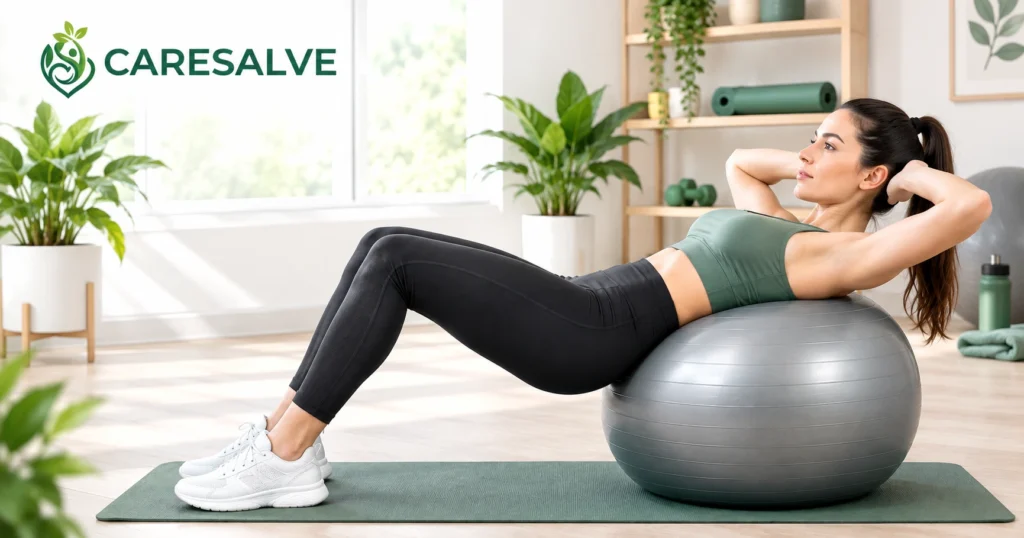
Sit on the ball and walk your feet forward until your lower and mid back rest comfortably on its curve, knees bent at about ninety degrees, feet flat on the floor. Place your hands lightly behind your head or crossed over your chest. Engage your abs and curl your upper body up and forward, then lower back down under control without letting your head drop back.
A common mistake here is pulling on the neck with the hands instead of initiating the movement from the abs, and letting the hips sink so the ball rolls out from under the lower back.
2. Stability Ball Oblique Crunch
From the same starting position as the standard crunch, rotate your torso slightly to one side, and curl up and across toward that hip, targeting the oblique muscles along the side of your abdomen. Keep the movement controlled and avoid using momentum to swing yourself up.
3. Stability Ball Knee Tuck
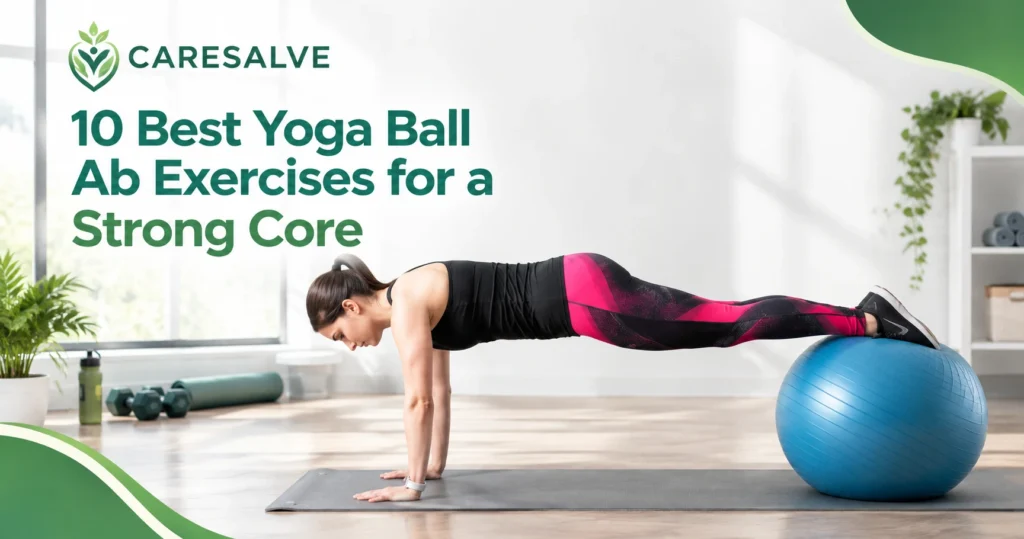
Start in a plank position with your shins or the tops of your feet resting on the ball and your hands under your shoulders. Keeping your core braced, bend your knees and roll the ball toward your chest, then extend your legs back out slowly to return to the plank.
4. Yoga Ball Bicycle Crunch
Lie back on the ball as you would for a standard crunch, hands lightly behind your head. Bring one knee up while rotating your opposite elbow toward it, then alternate sides in a slow, controlled pedaling motion. Avoid rushing through repetitions, since speed tends to reduce how much the obliques actually contract.
5. Stability Ball Tuck
Similar to the knee tuck but performed with your forearms on the floor and your shins on the ball rather than a full plank hand position, which can be a helpful regression for people still building shoulder and core stability. Pull the ball in toward your chest using your abdominal muscles, then extend back out with control.
6. Stability Ball Pike
From a plank position with your feet on the ball and hands under your shoulders, keep your legs straight and lift your hips up toward the ceiling, rolling the ball toward your hands, then lower back to the plank. This is a more advanced movement that demands significant shoulder stability along with core control, so it’s best introduced after you’re comfortable with the knee tuck.
7. Stability Ball Forearm Plank
Rest your forearms on top of the ball with your body extended into a straight line from head to heels, feet on the floor. Brace your abs, keep your hips level (not sagging or piked), and hold the position for time. Beginners can perform this with the ball against a wall for extra stability while learning the position.
8. Stability Ball Hip Thrust
Sit on the floor with your upper back resting against the ball, feet flat on the floor and knees bent. Lower your hips toward the floor, then drive them upward by squeezing your glutes and bracing your core, pausing briefly at the top before lowering back down.
9. Stability Ball Hands to Feet Pass
Lying on your back, hold the ball between your hands, extend your arms and legs to pass the ball from your hands to your feet, then lower both arms and legs slightly before bringing them back together to pass the ball back to your hands. Keep your lower back gently pressed toward the floor throughout to avoid excessive arching.
10. Stability Ball Wall Side Crunch
Kneel or stand beside a wall with the ball positioned between your hip and the wall. Lean into the ball and perform a controlled side crunch, bringing your elbow and hip toward each other, feeling the contraction along your oblique before returning to the start.
How to Build a Yoga Ball Ab Workout
Doing the exercises above in a structured routine, rather than randomly, is what turns them into a genuine core strengthening program.
Beginner Yoga Ball Ab Workout
- Yoga ball crunch
- Stability ball knee tuck
- Stability ball forearm plank
- 8 to 12 repetitions per exercise (or 20 to 30 seconds for the plank), 2 rounds
Intermediate Yoga Ball Ab Workout
- Yoga ball bicycle crunch
- Stability ball oblique crunch
- Stability ball pike
- Stability ball hip thrust
- Stability ball hands to feet pass
- 10 to 15 repetitions per exercise, 2 to 3 rounds
How Often Should You Do Yoga Ball Ab Exercises?
Current physical activity guidance from the Centers for Disease Control and Prevention advises adults to get at least 150 minutes of moderate intensity physical activity a week, along with muscle strengthening activity that works all the major muscle groups, including the abdomen, on two or more days a week. The same CDC guidance notes that strengthening work should aim for eight to twelve repetitions per set, ideally building toward two or three sets over time. A stability ball ab routine performed two to three times a week, with a rest day or a different type of training in between, fits comfortably within that recommendation. Progress gradually by adding repetitions, sets, or more advanced exercises rather than increasing everything at once.
Common Mistakes to Avoid During Yoga Ball Ab Exercises
- Using a ball that is too soft, too firm, or the wrong size for your height
- Moving quickly through repetitions instead of controlling the movement
- Letting the lower back arch excessively during extension based exercises
- Holding your breath instead of exhaling during the effort phase of a movement
- Jumping into advanced exercises like the pike or knee tuck before building basic balance on the ball
- Letting the hips sag or pike during plank based positions instead of keeping a straight line
Safety Tips for Using a Yoga Ball
- Exercise on a stable, non slip surface, away from sharp furniture edges
- Inspect the ball for cracks, punctures, or excessive wear before each use
- Keep enough clear space around you in case you lose your balance
- Begin with easier movements and progress only once you feel steady and in control
- Stop immediately if you feel sharp pain, and don’t push through joint or spinal discomfort
- If you have a back injury, a hernia, are pregnant, or have another medical condition, speak with a doctor or physical therapist before starting a new core exercise program
Key Takeaways
- A stability ball adds a balance challenge that can increase how much your core muscles have to work compared with the same exercise on a flat surface
- Start with basic movements such as the crunch, knee tuck, and forearm plank before progressing to more advanced ones like the pike
- Controlled form matters more than speed or number of repetitions
- A consistent routine performed two to three times a week fits within general muscle strengthening recommendations for adults
- Stop and seek professional guidance if you experience pain beyond normal muscle fatigue
Frequently Asked Questions
1. Is a yoga ball good for abs?
Yes. Research measuring muscle activity has found that several stability ball exercises produce high levels of activation in the abdominal muscles, in some cases higher than comparable exercises performed on a stable surface, because your core has to work to keep you balanced as well as to perform the movement itself.
2. What is the best yoga ball ab exercise for beginners?
The yoga ball crunch and the stability ball forearm plank are good starting points, since they let you get comfortable with the ball’s instability without requiring the shoulder strength and balance needed for more advanced moves like the pike or the hands to feet pass.
3. How long should you do a yoga ball ab workout?
A focused session of three to six exercises, with two to three rounds each, typically takes fifteen to twenty five minutes including a brief warm up. This fits comfortably alongside general activity guidelines that call for muscle strengthening work on two or more days a week.
4. Can yoga ball exercises strengthen your core?
Yes, when performed consistently as part of a structured routine. Because the ball challenges balance and control in addition to strength, it can be a useful complement to traditional floor based core exercises rather than a full replacement for them.
5. Are yoga ball and stability ball exercises the same?
Generally, yes. Yoga ball, stability ball, Swiss ball, exercise ball, and gym ball all refer to the same basic piece of equipment. The names are used somewhat interchangeably in everyday fitness content, though “Swiss ball” is the term most commonly used in exercise science literature.
This article is for general educational purposes and is not a substitute for personalized medical or professional fitness advice. If you have an existing injury, chronic condition, or are pregnant, consult a doctor or physical therapist before beginning a new exercise program. Read our full Editorial Policy to learn how we fact check content.
