


Introduction
Skin tags, medically known as acrochordons, are small, soft growths of skin that commonly appear on areas where skin rubs against skin or clothing. While they are harmless, patients frequently seek removal for comfort or cosmetic reasons, which means healthcare providers need to document and code these visits correctly.
Accurate ICD 10 coding is essential for proper diagnosis records, clear clinical documentation, and successful insurance claims. Using the wrong code, or failing to support a diagnosis with proper documentation, can lead to denied claims, delayed reimbursement, and compliance issues for a practice.
This guide covers everything providers, billers, and coders need to know about skin tag ICD 10 codes, related CPT codes for removal procedures, documentation requirements, medical necessity criteria, and common coding mistakes to avoid. Whether you are coding a routine dermatology visit or verifying insurance coverage, this resource will help you code with confidence.
What Is a Skin Tag (Acrochordon)?
Understanding what a skin tag actually is helps explain why certain codes apply and others do not.
What Are Skin Tags?
A skin tag is a small, soft, benign growth that hangs off the skin, often attached by a thin stalk called a peduncle. The medical term for this growth is acrochordon, though it is also sometimes referred to as a fibroepithelial polyp. Skin tags are noncancerous and typically painless unless irritated by friction, clothing, or jewelry.
Common Causes and Risk Factors
Several factors contribute to the development of skin tags, including:
- Aging, since skin tags become more common as people get older
- Obesity, particularly due to increased skin folds and friction
- Diabetes and insulin resistance
- Pregnancy, likely related to hormonal changes
- Repeated friction between skin surfaces or against clothing
- Family history, since genetics can play a role
Common Areas Where Skin Tags Develop
Skin tags most often appear in areas with frequent skin to skin contact or friction, including:
- The neck
- The armpits
- The eyelids
- The groin
- Under the breasts
What Is the ICD 10 Code for Skin Tags?
Before reviewing individual codes, it helps to understand what ICD 10 codes are and why they matter.
ICD 10 codes are standardized diagnosis codes used across the healthcare system to classify medical conditions. Every diagnosis documented during a patient visit needs a corresponding ICD 10 code so that the medical record accurately reflects the patient’s condition.
These codes are critical for healthcare documentation because they create a consistent, universal language that any provider, insurer, or auditor can interpret. They are equally important for reimbursement, since insurance companies use the diagnosis code to determine whether a procedure is medically necessary and therefore eligible for coverage.
Providers use ICD 10 codes not only for billing purposes but also to maintain accurate patient histories, support quality reporting, and comply with federal recordkeeping requirements. For a condition like a skin tag, selecting the correct code ensures that the removal procedure is properly linked to a valid, billable diagnosis.
Skin Tag ICD 10 Codes Explained
Several ICD 10 codes may apply to skin tags depending on their exact type and location, so it is important to understand the differences between them.
L91.8, Other Hypertrophic Disorders of the Skin
This is generally considered the primary and most commonly used code for skin tags. It falls under the broader category of hypertrophic skin disorders and is typically used when a provider diagnoses a standard skin tag that does not fall into a more specific category. Clinical examples include a patient presenting with one or more soft, pedunculated growths on the neck or underarms that a provider identifies as a typical skin tag during examination.
D23.9, Benign Neoplasm of Skin, Unspecified
Some providers may use this code when a skin tag is documented more broadly as a benign skin growth rather than specifically classified as a hypertrophic skin disorder. This code is sometimes selected when the exact nature of the lesion is not fully specified in the documentation, though more precise coding is always preferred when possible.
L98.8, Other Specified Disorders of the Skin and Subcutaneous Tissue
This code may be appropriate in situations where the skin condition does not fit neatly into other more specific categories but is still clearly documented by the provider as a distinct skin disorder. It functions as a catch all option for skin conditions that require specification beyond the more common codes.
K64.4, Residual Hemorrhoidal Skin Tags
This code applies specifically to skin tags that develop in the anal region as a result of resolved hemorrhoids, rather than to skin tags found elsewhere on the body. It is important not to confuse this code with the general skin tag codes, since it refers to a distinct clinical presentation tied to hemorrhoidal history.
ICD 10 for Acrochordon
Since acrochordon is simply the medical term for a skin tag, it does not have its own separate code. Instead, providers use the same codes discussed above, most often L91.8, when documenting a diagnosis of acrochordon.
Fibroepithelial Polyp ICD 10
Fibroepithelial polyp is another clinical term sometimes used interchangeably with skin tag or acrochordon, particularly in pathology reports. When this term is documented, the same primary codes apply, since it describes the same type of benign growth.
Related ICD 10 Codes Commonly Confused with Skin Tags
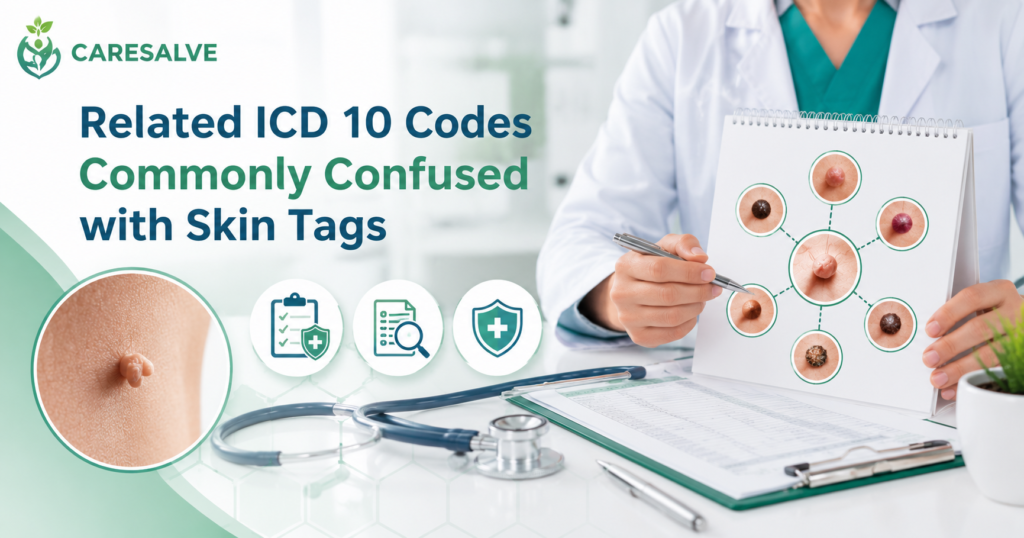
Several other skin conditions share similarities with skin tags or appear in similar body locations, which can lead to coding confusion if providers are not careful.
Heat Rash ICD 10
Heat rash, also known as miliaria, is an entirely different condition caused by blocked sweat ducts rather than a benign skin growth. It has its own distinct diagnosis code and should never be used interchangeably with skin tag codes.
L72.0, Epidermal Cyst
An epidermal cyst is a closed sac beneath the skin filled with keratin, which is structurally and clinically different from a skin tag. While both are benign, an epidermal cyst requires a different diagnostic and procedural approach.
L91.0, Hypertrophic Scar
A hypertrophic scar results from excess collagen production during wound healing and appears as raised, thickened scar tissue rather than a soft, pedunculated growth. Although it falls under a similar broader category as L91.8, it represents a completely different clinical finding.
Other Benign Skin Lesions
Other benign lesions, such as moles or seborrheic keratoses, may resemble skin tags to an untrained eye but require their own specific diagnosis codes. Choosing the correct code matters because it directly affects medical necessity determinations, reimbursement accuracy, and the integrity of the patient’s medical record.
CPT Codes for Skin Tag Removal
Once a diagnosis code is established, providers also need the correct procedure code to bill for the removal itself.
CPT Code for Removal of Skin Tags
The CPT code range most commonly associated with skin tag removal falls under codes designated for removal of skin tags, which typically account for the removal of a specified number of lesions in a single session. Coders should always verify the current CPT manual, since code selection often depends on the number of tags removed during the encounter.
CPT Code for Excision of Skin Tag
In cases where a more involved excision is performed, rather than a simple removal technique such as snipping or cauterization, a different excision code may apply. The choice between removal and excision codes depends on the technique used and should always be reflected accurately in the provider’s documentation.
ICD 10 Codes vs CPT Codes
It is important to understand the distinction between these two coding systems. The ICD 10 code represents the diagnosis, meaning the reason the patient needed care. The CPT code represents the procedure, meaning what was actually done during the visit. Both are required for billing, since an insurance claim needs to show both what condition was treated and what treatment was provided.
For example, a claim for skin tag removal might pair the diagnosis code L91.8 with a CPT code for removal of skin tags, showing the payer both the medical reason for the visit and the specific service performed.
When Is Skin Tag Removal Medically Necessary?
Insurance coverage often hinges on whether a removal is considered medically necessary rather than purely cosmetic.
Removal may be considered medically necessary when a skin tag causes:
- Pain or tenderness
- Bleeding, especially from repeated irritation
- Recurrent irritation from clothing, jewelry, or friction
- Infection or inflammation around the growth
- Vision obstruction, if located near the eyelid
- Suspicion of another underlying skin condition that requires further evaluation
On the other hand, removal performed purely for appearance, without any of the symptoms above, is typically classified as cosmetic. This distinction matters greatly for both coding and insurance purposes.
Insurance Coverage for Skin Tag Removal
Insurance coverage for skin tag removal depends heavily on how the procedure is classified.
When a skin tag causes documented symptoms such as pain, bleeding, or infection, insurance is more likely to cover the removal as a medically necessary procedure. However, when removal is requested solely for cosmetic reasons, most insurance plans will not provide coverage, and the patient may be responsible for the full cost.
To support a medically necessary claim, providers must include clear supporting documentation that explains the symptoms, clinical findings, and reasoning behind the decision to remove the skin tag. Without this documentation, even a legitimate medical case can be denied simply due to insufficient evidence in the record.
Documentation Requirements for Accurate ICD 10 Coding
Strong documentation is the foundation of accurate coding and successful reimbursement. Providers should always include:
- A clear diagnosis, including the specific type of skin lesion identified
- The exact lesion location on the body
- The number of skin tags present or removed
- The size of each lesion, when relevant
- Any symptoms reported by the patient, such as pain or bleeding
- A clear statement of medical necessity when applicable
- The specific procedure performed during the visit
- Detailed physician notes describing the clinical reasoning behind the diagnosis and treatment
Complete documentation not only supports accurate coding but also protects the practice in the event of an audit or insurance review.
Common Coding and Billing Mistakes to Avoid
Even experienced coders can make errors when handling skin tag diagnoses. Common mistakes include:
- Choosing the wrong ICD 10 code, such as confusing a skin tag with an unrelated skin condition
- Selecting an incorrect CPT code that does not match the procedure actually performed
- Missing documentation that fails to support medical necessity
- Coding a cosmetic removal as though it were medically necessary
- Missing required modifiers when multiple lesions are removed
- Poor or incomplete clinical notes that do not clearly justify the diagnosis or procedure
Avoiding these mistakes helps prevent claim denials, reduces the risk of compliance issues, and ensures patients receive accurate billing statements.
Quick Comparison Table: ICD 10 Codes for Skin Tags
| ICD 10 Code | Condition | Billable | When Used |
| L91.8 | Other hypertrophic disorders of skin | Yes | Most common skin tag diagnosis |
| D23.9 | Benign neoplasm of skin | Yes | Unspecified benign lesion |
| L98.8 | Other specified skin disorders | Yes | Other documented skin disorders |
| K64.4 | Residual hemorrhoidal skin tags | Yes | Anal skin tags |
| L72.0 | Epidermal cyst | No | Different diagnosis |
| L91.0 | Hypertrophic scar | No | Scar tissue |
| Heat Rash ICD 10 | Different skin condition | No | Not for skin tags |
Frequently Asked Questions
1. What is the ICD 10 code for skin tags?
The most commonly used code for skin tags is L91.8, which falls under other hypertrophic disorders of the skin.
2. What is the ICD 10 code for acrochordon?
Since acrochordon is the medical term for a skin tag, it is typically coded using L91.8 as well.
3. What is the ICD 10 code for fibroepithelial polyp?
A fibroepithelial polyp refers to the same type of growth as a skin tag, so the same primary codes, most commonly L91.8, apply.
4. What is the CPT code for skin tag removal?
CPT codes for skin tag removal depend on the number of lesions removed and the technique used, so providers should reference the current CPT manual for the exact code that matches the procedure performed.
5. Does insurance cover skin tag removal?
Insurance typically covers removal only when it is medically necessary, such as when the skin tag causes pain, bleeding, or irritation, rather than for purely cosmetic reasons.
6. What is the difference between ICD 10 and CPT codes?
ICD 10 codes represent the diagnosis, while CPT codes represent the procedure performed. Both are needed to properly bill an insurance claim.
7. Is heat rash the same as a skin tag?
No, heat rash is a completely different condition caused by blocked sweat ducts, and it is coded separately from skin tags.
8. Can multiple skin tags be billed together?
Yes, CPT codes for skin tag removal often account for a range in the number of lesions removed during a single visit, so multiple tags can typically be billed together under the appropriate code.
Conclusion
Skin tags are common, benign growths that require careful and accurate ICD 10 coding to ensure proper documentation and reimbursement. The primary diagnosis code, L91.8, applies to most standard skin tag cases, while related codes such as D23.9, L98.8, and K64.4 apply to more specific situations.
Pairing the correct diagnosis code with the appropriate CPT code for removal or excision is essential for successful billing. Just as important is thorough documentation that clearly supports medical necessity when applicable. By understanding these codes and avoiding common coding mistakes, providers and billers can support accurate patient records, reduce claim denials, and ensure proper reimbursement for skin tag related visits.
