

The human nervous system is often described as a network of neurons that carry electrical signals throughout the body. Yet neurons are only part of the story. Sitting alongside them, often outnumbering them, is another group of cells that rarely gets the spotlight but is absolutely essential for the brain and spinal cord to function properly. These are the glial cells.
What Are Glial Cells?
Glial cells, also called neuroglial cells or simply neuroglia, are non neuronal cells found throughout the central and peripheral nervous systems. The word glia comes from the Greek term meaning glue, which reflects an early belief that these cells simply held neurons together. Today we know that glial cells do far more than provide structural glue.
Neuroglia is defined as a diverse group of cells that support, protect, nourish, and regulate neurons. They do not typically generate or transmit electrical impulses the way neurons do, but without them neurons could not survive, communicate, or repair themselves after injury.
Glial cells are often referred to as supporting cells because their primary role is to maintain a stable, nourishing, and protective environment for neurons. This support includes everything from supplying nutrients and oxygen to forming insulating layers around nerve fibers and clearing away cellular debris.
Their importance in the nervous system cannot be overstated. Every major process in the brain, from learning and memory to immune defense and repair after injury, depends in some way on the activity of glial cells.
Glial Cells vs Neurons: What Is the Difference?
Neurons and glial cells work together, but they are structurally and functionally distinct. Neurons are the primary signaling cells of the nervous system, specialized to transmit electrical and chemical messages across long distances. Glial cells, in contrast, act as the supporting cells of the nervous system, maintaining the environment in which neurons operate.
| Feature | Neurons | Glial Cells |
| Function | Transmit electrical and chemical signals | Support, protect, and nourish neurons |
| Signal Transmission | Generate and conduct nerve impulses | Do not typically generate nerve impulses |
| Number | Fewer in most brain regions | Often equal to or greater in number than neurons |
| Regeneration | Limited capacity to regenerate | Many types retain the ability to divide and repair tissue |
This comparison shows why both cell types are necessary. Neurons carry the information, while glial cells make sure the system stays healthy enough for that information to travel efficiently.
Where Are Glial Cells Found?
Glial cells are present throughout the nervous system, though the specific types and their roles differ depending on location. Understanding where glial tissue exists helps explain why different glial cells have such varied jobs.
Central Nervous System (CNS)
The central nervous system, made up of the brain and spinal cord, contains several types of glial cells including astrocytes, oligodendrocytes, microglia, and ependymal cells. These cells regulate the chemical environment around neurons, produce the insulating myelin sheath, defend against infection, and help circulate cerebrospinal fluid.
Peripheral Nervous System (PNS)
The peripheral nervous system, which includes the nerves branching out from the brain and spinal cord to the rest of the body, relies mainly on Schwann cells and satellite cells. These glial cells insulate peripheral nerve fibers and support the neuronal cell bodies located in ganglia outside the CNS.
Types of Glial Cells
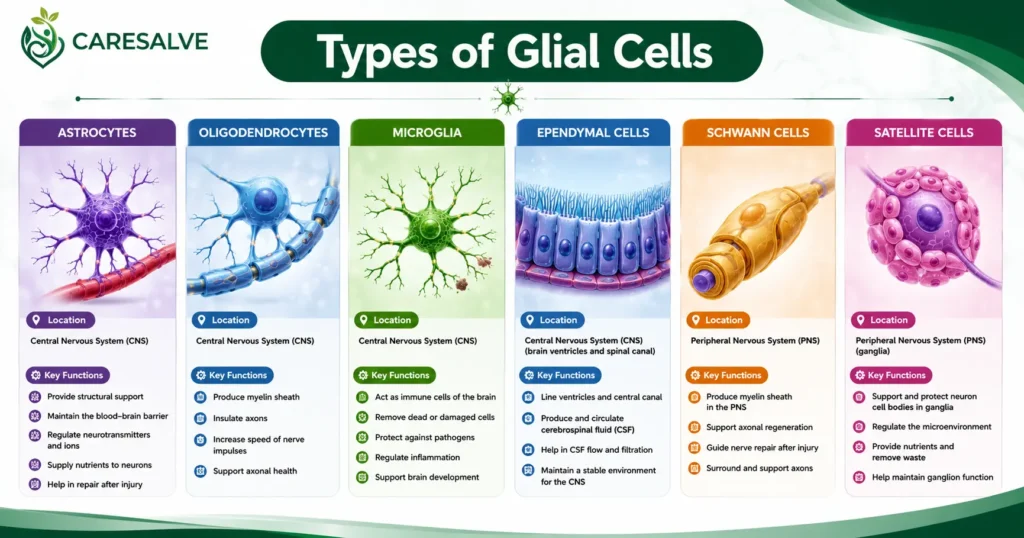
There are six major types of neuroglial cells, each with a distinct structure and function. Some are found only in the central nervous system, while others are unique to the peripheral nervous system.
Astrocytes
Astrocytes are star shaped glial cells and are the most abundant type found in the CNS. Their functions include:
Maintaining the blood brain barrier, which controls what substances can pass from the bloodstream into brain tissue Providing nutrient support to neurons by transporting glucose and other essential molecules Assisting in repair after brain injury by forming scar tissue and regulating inflammation
Astrocytes also play a role in regulating the chemical balance around synapses, which directly affects how well neurons communicate with one another.
Oligodendrocytes
Oligodendrocytes are responsible for producing the myelin sheath around neurons in the central nervous system. This fatty insulating layer allows electrical impulses to travel much faster along the nerve fiber, a process known as saltatory conduction. A single oligodendrocyte can wrap myelin around multiple neuronal axons at once, making it a highly efficient cell for supporting rapid nerve impulses.
Microglia
Microglia serve as the immune defense system of the brain and spinal cord. They constantly monitor the nervous system for signs of damage, infection, or disease. Their key roles include:
Detecting and responding to pathogens or injury Removing damaged or dead cells through a process called phagocytosis Regulating brain inflammation to prevent excessive tissue damage
When microglia become overactive or dysfunctional, they have been linked to chronic brain inflammation and neurodegenerative conditions.
Ependymal Cells
Ependymal cells line the ventricles of the brain and the central canal of the spinal cord. They are responsible for producing and circulating cerebrospinal fluid, which cushions the brain, removes waste products, and helps maintain a stable chemical environment. Cerebrospinal fluid produced by ependymal cells flows through the brain ventricles and around the spinal cord, providing continuous protection and nourishment.
Schwann Cells
Schwann cells are the peripheral nervous system equivalent of oligodendrocytes. Found only in the PNS, they wrap around individual peripheral nerve fibers to form myelin. Unlike oligodendrocytes, each Schwann cell myelinates only a single segment of one axon. Schwann cells are also critical for nerve regeneration, as they help guide the regrowth of damaged peripheral nerves and support recovery after injury.
Satellite Cells
Satellite cells surround neuron cell bodies within the ganglia of the peripheral nervous system. Their functions include:
Supporting the ganglia by providing structural stability Facilitating nutrient exchange between neurons and the surrounding tissue Offering protection against harmful substances and regulating the chemical environment
Although less well known than other glial cells, satellite cells play an important role in maintaining healthy peripheral nerve function.
Functions of Glial Cells
Neuroglial cells support and protect the nervous system in numerous ways. Below is a breakdown of their major functions.
Structural Support
Glial cells provide a physical framework that holds neurons in place, ensuring the organized architecture of the brain and spinal cord remains stable.
Nutrient Supply
Astrocytes and other glial cells help deliver glucose, amino acids, and other essential nutrients to neurons, supporting their high metabolic demands.
Myelin Formation
Oligodendrocytes in the CNS and Schwann cells in the PNS produce myelin, the insulating layer that dramatically increases the speed of nerve impulse conduction.
Brain Protection
Glial cells contribute to physical and chemical protection of neural tissue, including the maintenance of the blood brain barrier and the cushioning effect of cerebrospinal fluid.
Waste Removal
Microglia and astrocytes work together to clear metabolic waste products and cellular debris, helping to keep the nervous system clean and functioning efficiently.
Immune Defense
Microglia act as resident immune cells within the CNS, responding quickly to injury, infection, or abnormal protein buildup.
Blood Brain Barrier
Astrocytes help form and regulate the blood brain barrier, a selective boundary that protects the brain from harmful substances circulating in the blood while allowing essential nutrients through.
Maintaining Homeostasis
Glial cells regulate ion concentrations, particularly potassium, around neurons, helping maintain the stable environment needed for normal electrical activity.
Repair After Injury
Following damage to nervous tissue, glial cells mobilize to clear debris, form protective scar tissue, and in the case of Schwann cells, actively support the regeneration of damaged nerve fibers.
Supporting Synaptic Communication
Glial cells influence how effectively neurons communicate at synapses by regulating neurotransmitter levels and even releasing their own signaling molecules.
How Glial Cells Communicate With Neurons
For many years scientists believed communication in the nervous system was a one way relationship, with neurons doing all the signaling and glial cells simply providing background support. Modern research has changed this understanding significantly.
Two Way Communication
Glial cells and neurons engage in continuous two way communication. Neurons send signals that influence glial cell activity, while glial cells in turn release molecules that shape neuronal function and synaptic strength.
Tripartite Synapse
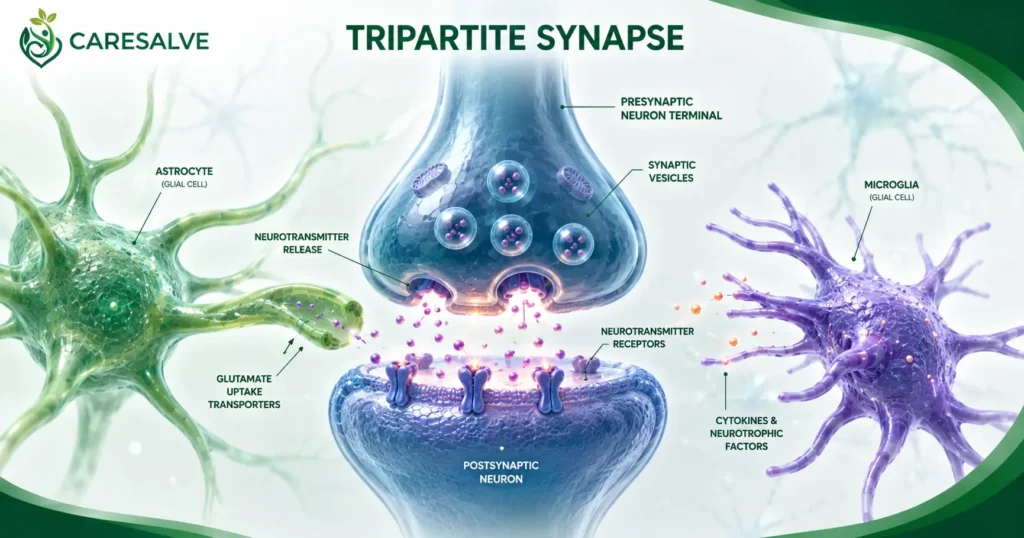
The concept of the tripartite synapse describes how astrocytes are now considered a functional part of the synapse, alongside the presynaptic and postsynaptic neurons. Astrocytes can detect neurotransmitter release and respond by influencing the surrounding synaptic activity.
Gliotransmission
Glial cells, particularly astrocytes, can release their own chemical messengers, known as gliotransmitters. This process, called gliotransmission, allows glial cells to actively modulate neuronal excitability and synaptic communication rather than simply reacting to it.
ATP Signaling
Adenosine triphosphate, or ATP, serves as an important signaling molecule between glial cells and neurons. Astrocytes and microglia release ATP to communicate with each other and with nearby neurons, coordinating responses to injury, inflammation, and changes in neural activity.
Why Glial Cells Are Important for Brain Function
Glial cells in the brain influence far more than basic maintenance. Emerging research continues to reveal how deeply involved they are in higher order brain functions.
Learning and memory formation depend partly on astrocytes, which help regulate synaptic plasticity, the process underlying how connections between neurons strengthen or weaken over time.
Sleep regulation also involves glial cells, with astrocytes playing a role in clearing metabolic waste from the brain during sleep through a system sometimes referred to as the glymphatic pathway.
Brain development relies heavily on glial cells, which guide migrating neurons to their correct locations and support the formation of proper neural circuits during early growth.
Cognitive function as a whole, including attention, processing speed, and emotional regulation, is influenced by the health and activity of glial cells throughout the nervous system.
Diseases Associated With Glial Cells
Because glial cells are so deeply involved in nervous system health, dysfunction in these cells is linked to a wide range of neurological conditions.
Multiple Sclerosis involves damage to the myelin sheath produced by oligodendrocytes, leading to disrupted nerve signal transmission and a range of neurological symptoms.
Alzheimer’s Disease has been associated with chronic activation of microglia and reactive changes in astrocytes, both of which may contribute to ongoing brain inflammation.
Parkinson’s Disease research has increasingly focused on the role of microglia driven inflammation in the degeneration of neurons involved in movement control.
Brain Tumors, particularly gliomas, arise directly from glial cells themselves, making them one of the most direct examples of how glial cell dysfunction can lead to serious disease.
ALS, or amyotrophic lateral sclerosis, involves complex interactions between motor neurons and surrounding glial cells, including astrocytes and microglia, which may accelerate neuronal damage.
Epilepsy has also been linked to abnormal astrocyte function, which can disrupt the balance of ions and neurotransmitters needed to prevent excessive neuronal firing.
Glial Cells Diagram
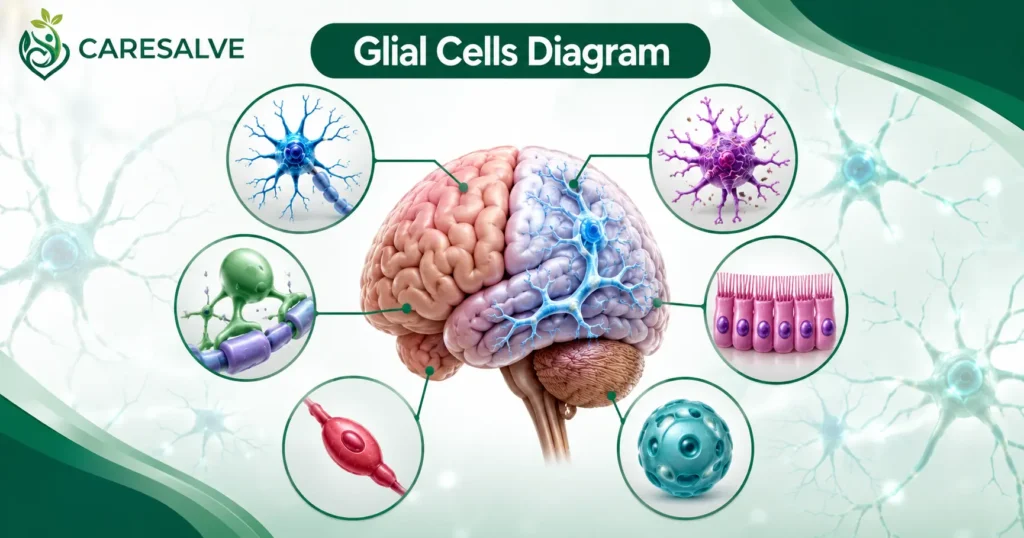
A labelled glial cells diagram is one of the most effective ways to visualize how these cells are organized within the nervous system. A comprehensive diagram would typically show the central nervous system on one side and the peripheral nervous system on the other, with each glial cell type labelled in its correct location.
In the CNS portion, the diagram would highlight astrocytes surrounding blood vessels and neurons, oligodendrocytes wrapping myelin around multiple axons, microglia patrolling the tissue, and ependymal cells lining the ventricles.
In the PNS portion, the diagram would show Schwann cells wrapped around individual peripheral axons and satellite cells surrounding neuron cell bodies within ganglia.
This type of visual is an excellent addition for readers who want a clear, at a glance understanding of how each glial cell type fits into the bigger picture of the nervous system.
Interesting Facts About Glial Cells
Glial cells outnumber neurons in several regions of the brain, challenging the long held assumption that neurons are the dominant cell type in neural tissue.
They actively communicate with neurons rather than simply existing as passive support structures, participating in real time signaling throughout the nervous system.
They influence learning and memory by regulating synaptic connections and supporting the biological processes underlying plasticity.
They participate in immune defense, with microglia acting as the brain’s primary line of protection against infection and injury.
They continue functioning throughout life, adapting to changes in the nervous system from early development through aging.
Frequently Asked Questions
1. What are glial cells?
Glial cells are non neuronal cells in the nervous system that support, protect, and nourish neurons while maintaining a stable environment for proper neural function.
2. What is another name for glial cells?
Glial cells are also known as neuroglia or neuroglial cells.
3. What is the function of neuroglial cells?
Neuroglial cells provide structural support, supply nutrients, form myelin, defend against infection, remove waste, and help maintain homeostasis within the nervous system.
4. How many types of glial cells are there?
There are six major types of glial cells: astrocytes, oligodendrocytes, microglia, ependymal cells, Schwann cells, and satellite cells.
5. Are glial cells neurons?
No, glial cells are not neurons. They do not typically generate or transmit electrical nerve impulses the way neurons do, though they do communicate with neurons through chemical signaling.
6. Which glial cells form myelin?
Oligodendrocytes form myelin in the central nervous system, while Schwann cells form myelin in the peripheral nervous system.
7. What are satellite cells?
Satellite cells are glial cells that surround neuron cell bodies within the ganglia of the peripheral nervous system, providing support, nutrient exchange, and protection.
8. What are supporting cells of the nervous system?
Supporting cells of the nervous system is another term for glial cells, referring to their role in maintaining and protecting neurons rather than transmitting signals themselves.
9. What is glial tissue?
Glial tissue refers to the collection of glial cells found throughout the central and peripheral nervous systems that work together to support neural function.
10. Why are glial cells important?
Glial cells are important because they maintain the health, protection, and proper functioning of neurons, without which the nervous system could not operate effectively.
Conclusion
Glial cells, or neuroglia, are far more than simple support structures within the nervous system. Defined by their role in nourishing, protecting, and regulating neurons, these cells work quietly but constantly behind the scenes of every thought, movement, and sensation the body experiences.
There are six major types of glial cells, each suited to a specific role. Astrocytes, oligodendrocytes, microglia, and ependymal cells operate within the central nervous system, while Schwann cells and satellite cells serve the peripheral nervous system.
Together, these cells contribute to brain protection, nutrient delivery, myelin formation, immune defense, and neuron support, making them indispensable to overall nervous system health. Their involvement in conditions such as multiple sclerosis, Alzheimer’s disease, and brain tumors highlights their clinical importance and underscores why continued research into glial cell biology remains such a vital area of neuroscience.
References
- National Institute of Neurological Disorders and Stroke (NINDS) – Brain Basics: Know Your Brain
https://www.ninds.nih.gov/health-information/public-education/brain-basics - National Center for Biotechnology Information (NCBI Bookshelf) – Neuroanatomy, Glial Cells
https://www.ncbi.nlm.nih.gov/books/ - National Library of Medicine (PubMed) – Research articles on glial cells and neuroglia
https://pubmed.ncbi.nlm.nih.gov/ - Cleveland Clinic – Nervous System: Function, Parts & Diseases
https://my.clevelandclinic.org/health/body/21202-nervous-system - Merck Manual Professional Edition – Overview of the Nervous System
https://www.merckmanuals.com/professional - Encyclopaedia Britannica – Neuroglia (Glial Cells)
https://www.britannica.com/science/neuroglia - StatPearls (NCBI Bookshelf) – Neuroanatomy, Glial Cells
https://www.ncbi.nlm.nih.gov/books/NBK551668/
