


Medical billing and coding accuracy is the backbone of a well-functioning healthcare system. When a patient undergoes an electrocardiogram and the results come back abnormal, providers, coders, and billing specialists must assign the right ICD-10 code to ensure proper reimbursement, compliance, and continuity of care. Among the most commonly referenced codes in cardiac diagnostics is R94.31, the designated ICD-10 code for an abnormal electrocardiogram result.
This guide breaks down everything you need to know about abnormal EKG ICD-10 coding, including when to use R94.31, how it compares to related codes, and best practices to avoid costly documentation errors. Whether you are a physician, coder, biller, or compliance officer, this resource serves as your go-to reference for accurate EKG-related coding.
What Is an Abnormal EKG?
An electrocardiogram, commonly referred to as an EKG or ECG, is a noninvasive diagnostic test that records the electrical activity of the heart. Electrodes placed on the skin detect signals as the heart beats, producing a graph of waveforms that represents how electrical impulses travel through cardiac tissue.
A normal EKG shows a predictable pattern of waves labeled P, Q, R, S, and T, each corresponding to a specific phase of the cardiac cycle. When one or more of these waveforms deviates from the expected pattern, the result is considered abnormal.
Common abnormal EKG findings include:
- ST segment elevation or depression, which may indicate ischemia or infarction
- T-wave inversions or flattening, often linked to myocardial changes
- Prolonged QT interval, which raises the risk of dangerous arrhythmias
- Bundle branch blocks, indicating conduction system disease
- Atrial fibrillation or flutter
- Ventricular hypertrophy patterns
- Low voltage QRS complexes
- Nonspecific ST and T-wave changes
Physicians typically order an EKG when a patient presents with chest pain, shortness of breath, palpitations, syncope, dizziness, or as part of a preoperative evaluation. Routine screenings for patients with cardiovascular risk factors also commonly include an EKG.
ICD-10 Code for Abnormal EKG (R94.31)
The official ICD-10-CM code for an abnormal EKG result is R94.31. The full description reads: “Abnormal electrocardiogram (ECG) (EKG).”
This code belongs to the R00 to R99 chapter of ICD-10-CM, which covers symptoms, signs, and abnormal clinical and laboratory findings not classified elsewhere. R94.31 is used specifically when an EKG produces a result that is outside normal parameters but no definitive cardiac diagnosis has yet been established.
When should you use R94.31? The code is appropriate in the following scenarios:
- The EKG is performed and the result is documented as abnormal, but no specific cardiac diagnosis is confirmed at the time of the encounter
- The provider notes nonspecific changes on the tracing without a firm clinical conclusion
- An incidental abnormal EKG is identified during a routine physical or preoperative workup and further evaluation is pending
- The abnormal result is the primary reason for the visit and no more specific code applies
Documentation requirements for R94.31 are straightforward but must be precise. The physician must explicitly document that the EKG is abnormal. The clinical note should include the specific finding observed, such as ST changes or T-wave flattening, to support the code and demonstrate medical necessity. Coding solely from the word “abnormal” without supporting clinical detail can trigger audit risk.
Example coding scenario: A 58-year-old male presents for a routine pre-surgical evaluation. His EKG shows nonspecific ST-T wave changes. No prior cardiac history is documented. The physician documents “abnormal EKG” and plans a cardiology referral. Appropriate code: R94.31.
What Does R94.31 Diagnosis Code Mean?
Breaking down R94.31 helps clarify its purpose and proper application.
The “R” category in ICD-10-CM denotes symptoms and abnormal findings that do not yet have a definitive diagnosis attached to them. “94” refers to abnormal results of function studies. The “.31” extension specifically identifies the electrocardiogram as the function study in question.
In clinical terms, R94.31 communicates that the electrical activity recorded by the EKG fell outside normal reference ranges, but that a specific underlying cardiac condition has not been confirmed. This is a holding code, used during the diagnostic process until a definitive diagnosis can be established.
Appropriate use cases for R94.31 include situations where the provider is still investigating the cause of the abnormal tracing, where the finding is incidental and being monitored, or where the changes are nonspecific and do not meet criteria for a more defined diagnosis.
R94.31 should NOT be used when:
- A specific cardiac diagnosis has already been confirmed. For example, if the EKG confirms atrial fibrillation, code I48.xx should be used instead.
- The EKG is performed as a monitoring tool for a known condition that already has its own established code.
- The abnormality is the result of a clearly identified cause that itself has a specific ICD-10 code, such as acute myocardial infarction.
ICD-10 Code for Abnormal ECG vs Abnormal EKG
One of the most common questions in cardiac coding involves the distinction between ECG and EKG. The answer is simple: they are the same test. ECG stands for electrocardiogram, using the Greek root “cardio.” EKG derives from the German “Elektrokardiogramm,” which was the original terminology used when the test was developed. Both acronyms are used interchangeably in clinical practice across the United States.
From a coding standpoint, this distinction is irrelevant. ICD-10-CM code R94.31 explicitly covers both acronyms, as reflected in its full description: “Abnormal electrocardiogram (ECG) (EKG).” Whether the ordering physician writes ECG or EKG in the documentation, the applicable code remains R94.31.
Clinicians and coders should not treat these as different tests or different codes. The only variation that matters is whether the result is normal or abnormal, and whether a specific diagnosis has been confirmed. If the result is normal, no diagnosis code is required for the EKG finding itself. If abnormal and undiagnosed, R94.31 applies.
From a documentation perspective, providers may write either ECG or EKG, and both will support the same code. What matters is the clinical description of the finding and its status as confirmed or unconfirmed.
Common Causes of Abnormal EKG Results
Understanding why an EKG comes back abnormal helps clinicians select the right follow-up codes and coders ensure that the underlying condition, when identified, receives a more specific diagnosis code.
- Arrhythmias are among the most frequent causes of abnormal tracings. These include atrial fibrillation, supraventricular tachycardia, ventricular tachycardia, bradycardia, and heart block. Once an arrhythmia is confirmed, it replaces R94.31 as the primary diagnosis code.
- History of myocardial infarction can leave permanent changes on the EKG, including Q waves in specific leads and ST segment alterations. These residual findings may persist indefinitely and warrant documentation of the prior MI using codes from the I25 category.
- Electrolyte disturbances significantly affect cardiac conduction. Low potassium (hypokalemia) can cause ST depression and T-wave flattening, while high potassium (hyperkalemia) produces peaked T-waves and widened QRS complexes. The electrolyte abnormality itself should be coded alongside or instead of R94.31 once confirmed.
- Structural heart disease, including left ventricular hypertrophy, cardiomyopathy, and valvular disease, produces characteristic EKG patterns. Confirmed structural diagnoses carry their own ICD-10 codes.
- Medication effects are a significant cause of EKG changes. Digoxin toxicity, antiarrhythmic drug effects, and QT-prolonging agents can all alter the tracing. When the cause is a known medication effect, both the drug-related code and the underlying condition may be relevant.
- Conduction abnormalities such as right or left bundle branch block, first-degree AV block, and Wolff-Parkinson-White syndrome each have their own specific ICD-10 codes and should be used in place of R94.31 once the specific conduction defect is confirmed.
Abnormal Stress Test ICD-10 Coding
A cardiac stress test, also known as an exercise tolerance test or exercise EKG, is a different procedure from a standard resting EKG. During a stress test, the patient exercises on a treadmill or stationary bike while the EKG is continuously monitored. The goal is to evaluate cardiac response to exertion and identify ischemia or arrhythmias that may only appear under physical demand.
Because a stress test is a distinct study from a resting EKG, it carries a different ICD-10 code when results are abnormal. The appropriate code for an abnormal exercise stress test is R94.39, which covers “Abnormal result of other cardiovascular function study.” Some coding references also point to Z13.6 for encounter screening purposes or to more specific codes based on the clinical finding uncovered.
Clinical scenarios where stress test coding applies include:
- A patient with exertional chest pain undergoes a stress test that reveals ST segment changes, suggesting ischemia. Code R94.39 is used pending definitive workup.
- A patient with known coronary artery disease has a stress test that shows reduced exercise capacity. The underlying coronary disease code takes precedence.
Documentation requirements for stress test coding mirror those for resting EKG coding. The physician must note that the result was abnormal, describe the specific abnormality observed, and indicate what clinical decision was made based on the finding.
Do not use R94.31 for an abnormal stress test. The codes serve different procedural contexts, and using the wrong one can result in claim denial.
Nonspecific T-Wave Abnormality ICD-10
T-wave changes are among the most commonly encountered and most frequently misunderstood findings on an EKG. The T-wave represents ventricular repolarization, and its shape, amplitude, and direction provide important clinical information.
When a T-wave is described as inverted, flattened, biphasic, or simply “abnormal” without a confirmed underlying cause, the finding may be coded as nonspecific ST-T wave changes. ICD-10-CM does not have a standalone code exclusively for nonspecific T-wave changes as a primary diagnosis in all clinical contexts. Depending on the documentation, R94.31 may be the most appropriate code when the finding is the only documented abnormality and no definitive diagnosis exists.
Common clinical causes of T-wave abnormalities include:
- Myocardial ischemia or infarction (in which case more specific codes apply)
- Left ventricular hypertrophy
- Bundle branch blocks
- Digoxin effect
- Hyperventilation
- Electrolyte disturbances
- Normal variant (particularly in young patients or in certain leads)
When T-wave changes are nonspecific and no underlying diagnosis is confirmed, R94.31 supports the abnormal EKG finding. If a specific cardiac condition has been identified as the cause, that condition’s code takes precedence. Coders should not assign R94.31 alongside a confirmed diagnosis unless the guidelines specifically permit dual coding for symptoms.
Low Voltage QRS ICD-10 Coding Considerations
Low voltage QRS is an EKG finding characterized by small deflection amplitudes across the limb leads (typically defined as QRS amplitude less than 5 mm in all limb leads) or precordial leads. It is not a diagnosis in itself but a finding that points toward a range of potential underlying conditions.
Associated conditions include:
- Pericardial effusion, where fluid surrounding the heart attenuates the electrical signal
- Pleural effusions
- Severe obesity
- Hypothyroidism
- Emphysema and chronic obstructive pulmonary disease
- Cardiac amyloidosis
- Dilated cardiomyopathy
ICD-10-CM does not have a unique, dedicated code specifically for “low voltage QRS” as an isolated finding. When this is the documented finding and no underlying diagnosis is confirmed, R94.31 is the appropriate code, as it captures the abnormal EKG result. Once an underlying condition is identified (for example, pericardial effusion coded as I31.3), the specific condition code replaces or supplements R94.31 as clinically appropriate.
Documentation should clearly state the EKG finding and include any clinical impression regarding the potential cause. If the provider suspects cardiac amyloidosis or another serious condition, further workup codes and referral documentation should be included to support medical necessity.
Abnormal EEG ICD-10 vs Abnormal EKG ICD-10
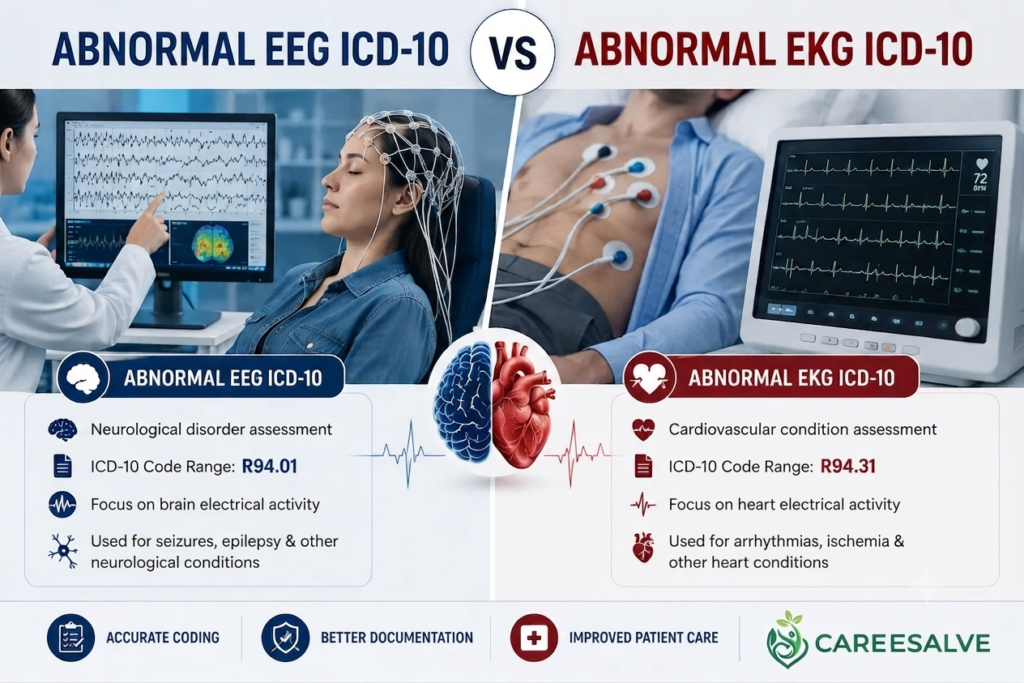
EEG and EKG are two entirely different diagnostic tests measuring different organ systems, yet they are frequently confused due to their similar abbreviations. This confusion leads to real-world coding errors that can result in claim denials and compliance issues.
An EEG, or electroencephalogram, records electrical activity in the brain and is used in neurology for evaluating seizures, epilepsy, encephalopathy, and sleep disorders. An EKG records electrical activity in the heart and is used in cardiology for evaluating arrhythmias, ischemia, and conduction problems.
The ICD-10 code for an abnormal EEG is R94.01, which falls under “Abnormal electroencephalogram.” The ICD-10 code for an abnormal EKG is R94.31. These codes are not interchangeable and serve completely different clinical purposes.
Common coding mistakes involving these two tests include:
- Assigning R94.31 when the documentation refers to a neurological study
- Confusing EEG and EKG in the medical record itself, which may reflect a transcription error in the original documentation
- Using a cardiology code in a neurology encounter or vice versa
When auditing a claim, reviewers will check that the procedure performed matches the diagnosis code assigned. Assigning R94.31 in a neurology visit where an EEG was performed will raise red flags. Always verify which study was actually performed and document accordingly.
When Not to Use R94.31
Knowing when not to use R94.31 is as important as knowing when to use it. Using this unspecified code when a more precise code is available is a common compliance issue that can attract audit scrutiny and create problems with payer reimbursement.
Do not use R94.31 when:
A confirmed cardiac diagnosis is present. If the EKG confirms atrial fibrillation, use the appropriate I48 code. If it confirms a myocardial infarction, use the appropriate I21 or I22 code. R94.31 is reserved for situations where no confirmed diagnosis exists.
Arrhythmia-specific codes apply. ICD-10-CM has specific codes for bradycardia (R00.1), tachycardia (R00.0), atrial flutter (I48.3), and many other rhythm disturbances. These codes should replace R94.31 when the arrhythmia is clearly identified.
Acute MI coding is required. ST elevation myocardial infarction and non-ST elevation myocardial infarction each have dedicated code series (I21.x) that must be used when these diagnoses are established. Using R94.31 in place of an MI code is both clinically inaccurate and a compliance risk.
The EKG is normal. If the tracing is within normal limits, there is no basis for assigning R94.31. A normal EKG result does not generate a diagnosis code.
Documentation pitfalls to watch for include physicians writing “EKG changes” without specifying whether the changes are clinically significant, or noting a finding like “possible left ventricular hypertrophy” without confirming the diagnosis. In outpatient settings, uncertain diagnoses (“possible,” “probable,” “suspected”) should not be coded as confirmed conditions. Instead, code the sign, symptom, or finding itself, which may support the use of R94.31.
Documentation Best Practices for Accurate Coding
Accurate ICD-10 coding for abnormal EKG findings begins with clear, complete physician documentation. Without thorough notes, even the most skilled coder cannot assign the correct code.
Physician documentation requirements for R94.31 and related codes include:
- A clear statement that the EKG result is abnormal
- A description of the specific finding (e.g., “EKG shows nonspecific ST-T wave changes in leads V4 through V6”)
- The clinical context, including the reason the EKG was ordered
- The physician’s assessment of the finding and any planned follow-up
- Notation of whether the finding is new or represents a chronic or known condition
Supporting clinical notes should correlate with the EKG finding. If a patient presents with chest pain and has an abnormal EKG, both the symptom (chest pain) and the finding (R94.31) may be coded together, depending on payer guidelines.
Audit readiness requires that documentation support every code assigned. Payers may request records to justify the use of R94.31, particularly when it appears as the primary diagnosis on a cardiology claim. The clinical note must tell a coherent story: why the test was ordered, what was found, and what was done as a result.
Payer expectations vary but generally follow CMS guidelines. Medicare and most commercial payers expect that unspecified or symptom-based codes like R94.31 are used only when a more specific code is not available, and that the physician’s documentation clearly supports the code chosen.
Common Coding Mistakes to Avoid
Even experienced coders make preventable errors when handling abnormal EKG claims. Here are the most common mistakes and how to avoid them.
Using unspecified codes when specific codes are available. R94.31 is an unspecified finding code. If the physician has documented a specific diagnosis, that diagnosis code must be used. Defaulting to R94.31 when a more precise option exists is a coding compliance issue.
Coding symptoms instead of confirmed diagnoses. Conversely, some coders assign symptom codes for findings that the physician has actually confirmed as a diagnosis. If the physician writes “this patient has atrial fibrillation as evidenced by the EKG,” the confirmed diagnosis code must be used, not R94.31.
Incorrect use of R94.31 alongside conflicting codes. Assigning R94.31 and a confirmed cardiac diagnosis code simultaneously without guidance from coding guidelines or physician clarification is contradictory. The abnormal finding code is meant for undiagnosed or unspecified situations.
Missing supporting documentation. Assigning R94.31 without a physician note describing the abnormality leaves the claim vulnerable. Always ensure the record supports every code assigned.
Failing to query the physician when documentation is ambiguous. If the EKG report says “abnormal” but the physician note does not address the finding, the coder should query the provider before assigning any code. Do not code from the EKG tracing report alone without corresponding physician interpretation.
Real-World Coding Examples
Routine Physical with Incidental Abnormal EKG
A 62-year-old woman presents for an annual wellness visit. She reports no cardiac symptoms. As part of the evaluation, an EKG is performed and shows nonspecific ST-T wave changes in the lateral leads. The physician documents the finding as an incidental abnormal EKG and refers the patient to cardiology for further evaluation. No cardiac diagnosis is confirmed at this encounter.
Correct codes: Z00.00 (encounter for general adult medical examination without abnormal findings as primary, may be adjusted based on findings), R94.31 (abnormal EKG as an additional code).
The key here is that no specific cardiac diagnosis has been established. R94.31 correctly captures the finding while the referral is documented as the clinical action taken.
Abnormal Stress Test Requiring Follow-Up
A 55-year-old male with hypertension and hyperlipidemia undergoes a cardiac stress test due to exertional chest pain. The test shows ST segment depression during exercise. The physician documents the result as an abnormal stress test and recommends cardiac catheterization.
Correct codes: R07.9 (chest pain, unspecified) as the reason for the encounter, R94.39 (abnormal result of other cardiovascular function study) for the stress test finding. Note that R94.31 would be incorrect here because a resting EKG was not the study performed.
Nonspecific T-Wave Changes on ECG
A 48-year-old male presents with fatigue and mild palpitations. A resting EKG is obtained and shows T-wave flattening in the inferior leads. The physician documents “nonspecific T-wave changes on ECG, etiology unclear, ordering additional labs and Holter monitor.”
Correct code: R94.31. The finding is abnormal, the physician has not confirmed a specific diagnosis, and further workup is ongoing. The T-wave changes represent an abnormal EKG result without a definitive underlying cause documented at this time.
Low Voltage QRS Finding
A 70-year-old female with a history of hypothyroidism presents for a follow-up visit. An EKG is performed and shows low voltage QRS complexes. The physician documents the finding and orders a thyroid function panel and an echocardiogram to evaluate for pericardial effusion, but does not confirm a new diagnosis at this visit.
Correct code: R94.31 (abnormal EKG). The hypothyroidism (E03.9) would also be coded as a coexisting condition. Until a specific new diagnosis is confirmed, R94.31 appropriately represents the abnormal EKG result.
Frequently Asked Questions
1. What is the ICD-10 code for abnormal EKG?
The ICD-10 code for an abnormal EKG is R94.31. The full official description is “Abnormal electrocardiogram (ECG) (EKG).” This code is used when the EKG result is outside normal limits and no specific cardiac diagnosis has been confirmed. It belongs to the R00 to R99 chapter of ICD-10-CM, which covers symptoms and abnormal findings not yet classified under a definitive diagnosis.
2. What does R94.31 mean?
R94.31 is the ICD-10-CM diagnosis code indicating that an electrocardiogram produced an abnormal result. The “R” identifies it as a symptom or abnormal finding code. The “94” refers to abnormal results of function studies, and “.31” specifically designates the electrocardiogram. Clinically, it means the electrical tracing of the heart deviated from expected norms without a confirmed underlying cardiac diagnosis at the time of the encounter.
3. Is ECG the same as EKG?
Yes. ECG (electrocardiogram) and EKG (from the German “Elektrokardiogramm”) refer to the same diagnostic test. Both terms are accepted in clinical practice and documentation. For coding purposes, ICD-10-CM code R94.31 covers both terms equally, as reflected in the code description itself: “Abnormal electrocardiogram (ECG) (EKG).”
4. What is the ICD-10 code for an abnormal stress test?
An abnormal stress test is coded differently from a resting EKG. The appropriate code for an abnormal exercise or cardiac stress test result is R94.39, “Abnormal result of other cardiovascular function study.” Do not use R94.31 for stress test findings, as that code applies specifically to resting electrocardiogram results.
5. Can R94.31 be used for nonspecific T-wave abnormalities?
Yes, in most cases. When T-wave abnormalities are documented as nonspecific, unexplained, or under investigation, and no specific cardiac diagnosis has been confirmed, R94.31 is the appropriate code. It captures the abnormal EKG result as a finding pending further evaluation. If the T-wave changes are attributed to a confirmed condition such as ischemia or left ventricular hypertrophy, the confirmed diagnosis code should be used instead.
6. How is low voltage QRS coded?
There is no standalone ICD-10-CM code for low voltage QRS as an isolated finding. When this is the only documented abnormality and no underlying diagnosis has been confirmed, R94.31 is used to represent the abnormal EKG result. Once an underlying condition is identified, such as pericardial effusion or cardiac amyloidosis, the specific condition code takes precedence. Documentation should describe the finding clearly and note any planned workup to support medical necessity.
7. Is abnormal EEG coded the same as abnormal EKG?
No. These are entirely different tests measuring different systems. An abnormal EEG (electroencephalogram, which measures brain activity) is coded as R94.01. An abnormal EKG (electrocardiogram, which measures heart activity) is coded as R94.31. Confusing these codes is a common and serious coding error that can lead to claim denials and compliance issues. Always verify which test was performed before assigning a code.
Conclusion
Accurate coding of abnormal EKG findings is essential for compliant billing, quality care documentation, and proper reimbursement. ICD-10-CM code R94.31 serves a specific and important role in the coding system: it captures the abnormal electrocardiogram result when no definitive cardiac diagnosis has yet been established.
Key takeaways for providers and billers include: use R94.31 only when the EKG is documented as abnormal and no more specific diagnosis has been confirmed; do not use it when a confirmed arrhythmia, myocardial infarction, or other specific cardiac condition has been diagnosed; recognize that ECG and EKG refer to the same test and use the same code; and always ensure physician documentation clearly describes the finding, its clinical context, and the plan of care.
For abnormal stress tests, use R94.39 rather than R94.31. For abnormal brain activity studies, use R94.01 and not the cardiac code. Precision in code selection reflects precision in clinical care, and both contribute to better outcomes for patients and healthcare organizations alike.
When in doubt, query the physician, review the documentation thoroughly, and apply the most specific code supported by the medical record. Proper use of R94.31 and related codes protects providers during audits, supports continuity of care, and ensures that the work clinicians do is accurately represented in the billing record.
